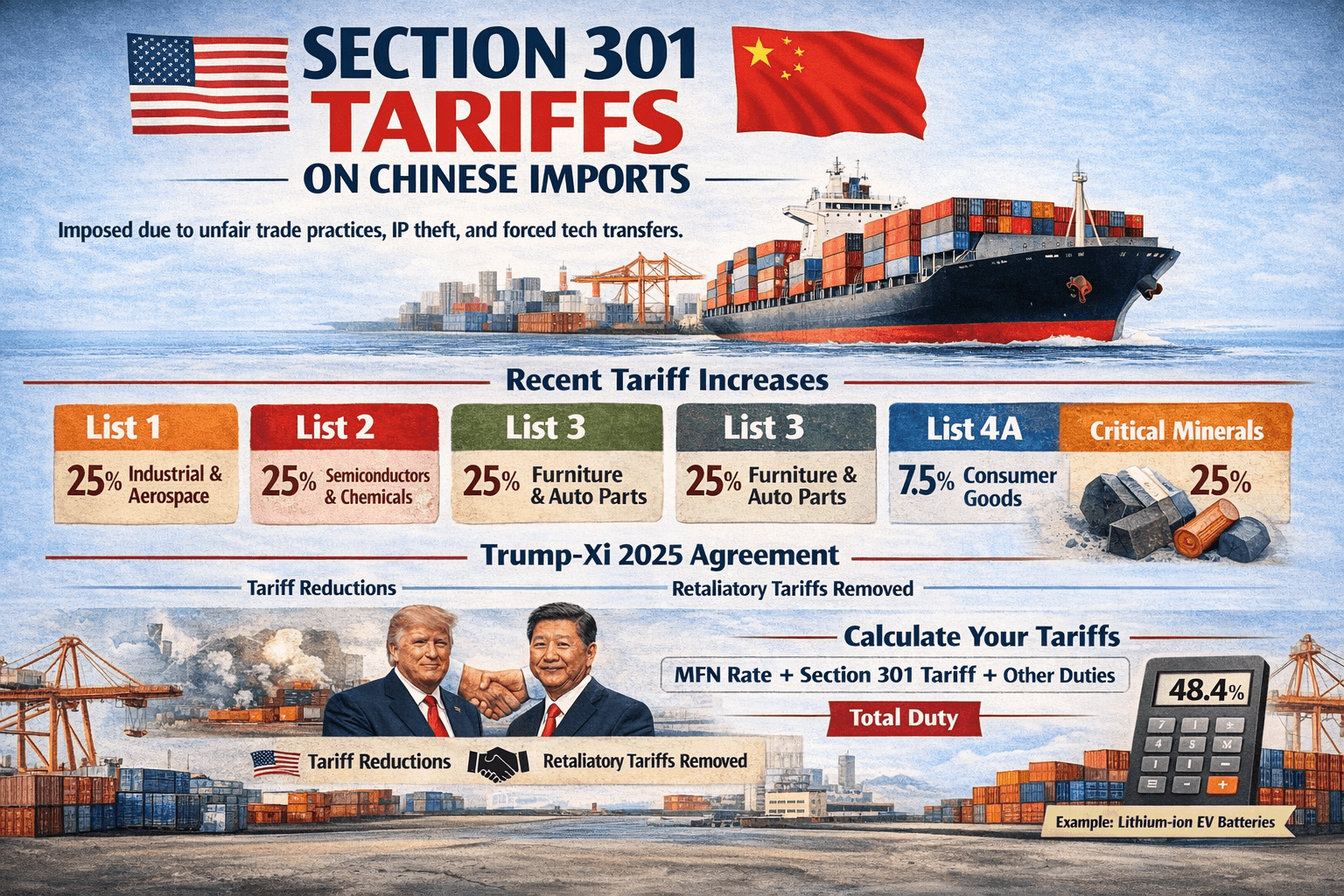
Section 301 tariffs are additional duties imposed on Chinese imports under Section 301 of the Trade Act of 1974. The U.S. Trade Representative (USTR) first implemented these tariffs in 2018 after an investigation found that China engaged in unfair trade practices, including forced technology transfers from U.S. companies, intellectual property theft, discriminatory licensing restrictions, and state-sponsored acquisition of U.S. technology.
These tariffs are in addition to the standard Most Favored Nation (MFN) duty rates in the Harmonized Tariff Schedule.
Current Section 301 Tariff Rates (January 2026)
Section 301 tariffs are organized into four lists, each covering different product categories:
List 1 covers industrial machinery, electronics, and aerospace products at a 25% tariff rate, effective July 2018.
List 2 covers semiconductors, plastics, and chemicals at a 25% tariff rate, effective August 2018.
List 3 covers furniture, auto parts, and building materials at a 25% tariff rate, effective September 2018.
List 4A covers consumer goods, apparel, and footwear at a 7.5% tariff rate, effective February 2020.
Important: List 4B tariffs were suspended in December 2019 as part of the Phase One agreement and remain suspended.
2024-2026 Tariff Increases on Strategic Sectors
Following USTR's four-year statutory review in 2024, tariff rates were increased on products in strategic sectors. Here are the current rates as of January 2026:
Electric Vehicles and Batteries
Electric vehicles increased from 25% to 100% in 2024 and remain at 100%.
EV lithium-ion batteries increased from 7.5% to 25% in 2024.
Non-EV lithium-ion batteries increased from 7.5% to 25% in January 2026.
Battery parts increased from 7.5% to 25% in 2024.
Solar and Semiconductors
Solar cells and modules increased from 25% to 50% in 2024.
Semiconductors increased from 25% to 50% in 2025.
Polysilicon and wafers increased from 25% to 50% in 2025.
Medical Products
Respirators and face masks increased from 0-7.5% to 25% in 2025, then to 50% in January 2026.
Medical gloves increased from 7.5% to 50% in 2025, then to 100% in January 2026.
Syringes and needles increased from 0% to 100% in 2024.
Critical Minerals and Materials
Natural graphite increased from 0% to 25% in January 2026.
Permanent magnets increased from 0% to 25% in January 2026.
Steel and aluminum products increased from 0-7.5% to 25% in 2024.
Other Strategic Products
Ship-to-shore cranes are now subject to a 25% tariff as of 2024.
Tungsten products are now subject to a 25% tariff as of 2024.
The November 2025 Trump-Xi Agreement
Following the meeting between Presidents Trump and Xi in South Korea on October 30, 2025, both countries agreed to significant tariff modifications effective November 10, 2025.
U.S. Actions
Fentanyl tariffs were reduced from 20% to 10% on all Chinese imports.
Reciprocal tariffs were suspended, though the 10% reciprocal tariff remains in place. Higher rates are suspended until November 10, 2026.
Section 301 exclusions were extended, with 178 product exclusions now valid until November 10, 2026.
Maritime tariffs under Section 301 for shipbuilding were delayed one year.
China's Actions
China removed retaliatory tariffs of 10-15% on U.S. agricultural goods.
China suspended export restrictions on gallium, germanium, antimony, and graphite until November 27, 2026.
China committed to purchasing 25 million metric tons of U.S. soybeans annually through 2028.
How Tariffs Stack: Calculating Your Total Duty
When importing from China, multiple tariff layers can apply simultaneously. Here's how they stack:
Total Duty = MFN Rate + Section 301 Rate + Fentanyl Tariff + Reciprocal Tariff + Section 232 (if applicable)
Example Calculation
Importing lithium-ion batteries for electric vehicles (HTS 8507.60.00):
The MFN base duty is 3.4%. Add the Section 301 List 1 tariff of 25%. Add the fentanyl tariff of 10%. Add the reciprocal tariff of 10%. The total effective rate is 48.4%.
For certain products like steel, aluminum, and automobiles, Section 232 tariffs may also apply, pushing effective rates even higher.
Section 301 Exclusions
USTR maintains an exclusion process that allows importers to request relief from Section 301 tariffs for specific products. As of January 2026:
Current Exclusions (Valid Until November 10, 2026)
178 product exclusions are currently active, covering solar manufacturing equipment, machinery components, plastic films and electric motors, medical devices, and certain fabrics and vehicle components.
Machinery Exclusion Process
For machinery classified under HTS Chapters 84 and 85, importers can request exclusions through USTR's electronic portal if they can demonstrate that the equipment is essential for domestic manufacturing, no reasonably available domestic alternative exists, and the tariff would cause severe economic harm.
Which Products Are NOT Subject to Section 301 Tariffs?
Not all Chinese imports face Section 301 tariffs. Products NOT on Lists 1-4A include certain pharmaceuticals, some raw materials, products with active exclusions, and items on the suspended List 4B.
Pro tip: Use our HTS Code Lookup Tool to check if your product is on a Section 301 list.
Strategies to Reduce Section 301 Tariff Exposure
1. Verify Country of Origin
Section 301 tariffs apply only to products with China as the country of origin. If your product undergoes substantial transformation in another country like Vietnam or Mexico, it may qualify for a different country of origin.
Caution: Transshipment schemes that merely relabel goods without substantial transformation are illegal and subject to severe penalties.
2. Check for Active Exclusions
Before paying duties, verify whether your specific product has an active exclusion. Exclusions are granted at the 10-digit HTS level, so precise classification matters.
3. Apply for Exclusions
If no exclusion exists for your product, you may be able to apply for one. The process requires demonstrating that the product is not available from non-Chinese sources, the tariff causes severe economic harm, and the product is not strategically important to China's industrial policy.
4. Use Foreign Trade Zones (FTZ)
While FTZs don't eliminate Section 301 duties, they can provide cash flow benefits by deferring duty payment until goods enter U.S. commerce.
5. Duty Drawback
If you import Chinese goods and then re-export them, either as-is or incorporated into other products, you may recover up to 99% of duties paid through the duty drawback program.
6. First Sale Valuation
If your supply chain involves multiple sales before goods reach the U.S., you may be able to use the first (lower) sale price for duty calculation rather than the final transaction value.
How to Determine If Your Product Is Subject to Section 301 Tariffs
Step 1: Classify your product with the correct 10-digit HTS code.
Step 2: Check if that HTS code appears on Lists 1, 2, 3, or 4A.
Step 3: Verify no active exclusion applies.
Step 4: Calculate total duty including MFN, Section 301, and other applicable tariffs.
Use our Free Tariff Calculator to instantly calculate your total landed cost including all applicable tariffs.
Timeline: Key Dates for 2026
January 1, 2026: Non-EV lithium batteries increase to 25%. Medical gloves increase to 100%. Face masks increase to 50%. Natural graphite and permanent magnets increase to 25%.
November 10, 2026: Current Section 301 exclusions expire unless extended.
November 10, 2026: Trump-Xi tariff reduction agreement expires unless renewed.
Frequently Asked Questions
Do Section 301 tariffs apply to goods from Taiwan or Hong Kong?
Taiwan: No. Taiwan is separately governed and not subject to China Section 301 tariffs.
Hong Kong: Generally no, but goods must genuinely originate in Hong Kong. Goods merely transshipped through Hong Kong but manufactured in mainland China are still subject to Section 301 tariffs.
Can I get a refund for Section 301 tariffs already paid?
If a retroactive exclusion is granted for your product, you may be able to recover duties through a Post Summary Correction (PSC). Consult with a licensed customs broker.
Are Section 301 tariffs legal?
The U.S. Court of Appeals for the Federal Circuit upheld the legality of Section 301 tariffs on Lists 3 and 4A in September 2025. However, legal challenges to other tariff actions, particularly IEEPA tariffs, are ongoing.
How do I stay updated on Section 301 changes?
Monitor USTR Federal Register notices, subscribe to CBP trade updates, and use Gateway Lines' tariff intelligence tools.
Resources
Gateway Lines Tariff Calculator
Calculate Your Section 301 Tariff Exposure
Don't guess at your landed costs. Use Gateway Lines' free tariff calculator to instantly determine your total duty rate, including Section 301 tariffs, fentanyl tariffs, and all other applicable duties.
This guide is for informational purposes only and does not constitute legal or customs advice. Tariff rates and regulations change frequently. Always verify current rates with CBP or a licensed customs broker before making importing decisions.