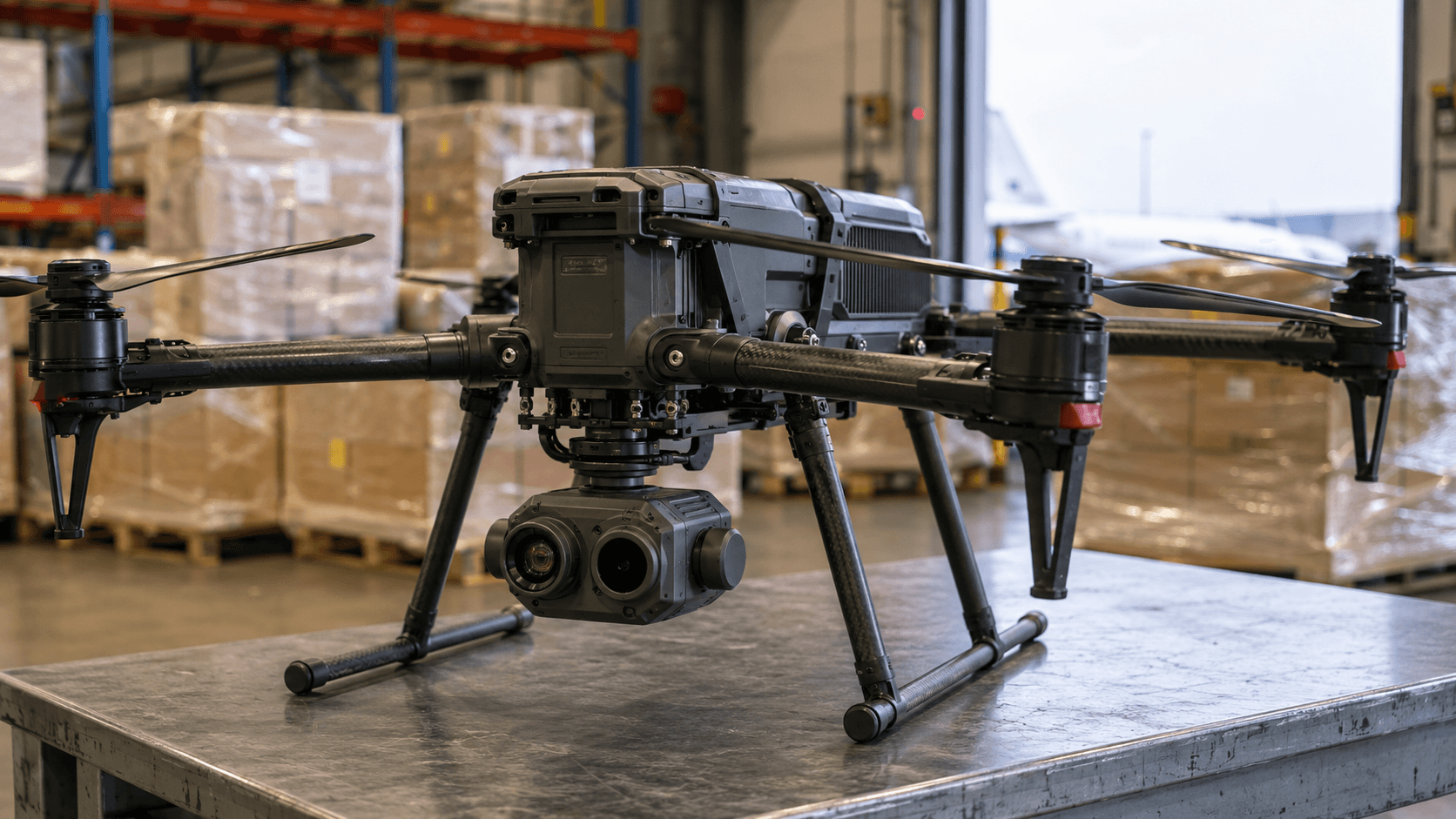
Section 232 duties on unmanned aircraft systems take effect at 12:01 a.m. eastern time on September 3, 2026. The rates are 100 percent and 25 percent, they apply to every origin, and they stack on top of everything you already pay.
Most coverage stops there. The operational problem starts one level down.
Six subheadings appear on both the 100 percent list and the 25 percent list. Same code, two rates, four times apart. What separates them is a hardware specification that the Harmonized Tariff Schedule does not record anywhere.
If you import drones, your classification will not tell you your duty rate. You need the spec sheet.
Key facts
Authority: Section 232, Trade Expansion Act of 1962 (19 U.S.C. 1862)
Instrument: Proclamation 11055 of August 13, 2026, 91 FR 53699, published August 19, 2026
Effective: 12:01 a.m. eastern time, September 3, 2026, for Annex I and Annex II
Second phase: 12:01 a.m. eastern time, February 9, 2027, for Annex III components
Rates: 100 percent on Annex I, 25 percent on Annex II, 25 percent on Annex III from February 2027
Countries: all origins, with ceilings for certain allied partners
Filing headings: 9903.08.20 through 9903.08.26, U.S. note 43
CBP guidance: not yet issued as of August 24, 2026
The six codes that sit on both lists
The proclamation splits unmanned aircraft into two annexes. Annex I carries 100 percent and covers aircraft with a maximum take-off weight above 25 kilograms, aircraft that integrate thermal imagers, docking stations, and certain critical components. Annex II carries 25 percent and covers aircraft at or below 25 kilograms.
Read those two descriptions again and the overlap becomes obvious. A drone can be under 25 kilograms and still carry a thermal imager. It lands on Annex I.
The result is that these six subheadings appear on both lists:
8806.21.00
8806.22.00
8806.23.00
8806.91.00
8806.92.00
8806.93.00
The codes that are already at 100 percent on weight alone
The six subheadings above are the aircraft at or below 25 kilograms, which is why a thermal imager is what moves them. Above that weight there is nothing to decide. Annex IV note 43(c)(1) reaches four further subheadings unconditionally: 8806.24.00 and 8806.94.00, both covering a take-off weight of more than 25 kilograms and not more than 150 kilograms, and 8806.29.00 and 8806.99.00, which state no weight at all.
If you enter under 8806.29.00 or 8806.99.00, get the take-off weight on paper from your supplier before September 3.
The subheading tells you the take-off weight band and whether the aircraft flies under remote control. It does not record thermal imaging. Nothing in chapter 88 does. So two shipments can be classified identically, entered on the same day, and owe rates that differ by a factor of four.
Confirm the imaging specification with your supplier before you cost the order, not after the container is on the water.
What that looks like in dollars
Take a 100,000 dollar order of Chinese drones under 8806.22.00, aircraft with a maximum take-off weight above 250 grams and not more than 7 kilograms.
Run it through the Gateway tariff calculator at tariff.gatewaylines.com today and it returns a Column 1 rate of Free, Section 301 List 1 at 25 percent, 346.40 in merchandise processing fee and 125 in harbor maintenance fee. Total duty, 25,000 dollars.
From September 3 the same line splits.
If the aircraft has no thermal imager, it sits on Annex II. Section 301 at 25 percent plus Section 232 at 25 percent is 50 percent, or 50,000 dollars.
If it integrates a thermal imager, it sits on Annex I. Section 301 at 25 percent plus Section 232 at 100 percent is 125 percent, or 125,000 dollars.
Same code. Same shipment. Same broker. A 75,000 dollar spread that turns on one line of a spec sheet.
Clause 3 of the proclamation is explicit that these duties apply in addition to any other duties, taxes, fees, exactions and charges. There is no netting against Section 301.
Parts are a two date problem, and an end use problem
Aircraft parts under 8807.10.00, 8807.20.00, 8807.30.00 and 8807.90.90 are treated differently depending on where they are going.
From September 3 those parts are covered at 100 percent only when destined for an unmanned aircraft system above 25 kilograms, and the annex carves out systems for retail delivery, agricultural use, or sale to the Department of War. From February 9, 2027, unmanned aircraft parts generally pick up 25 percent under Annex III. Parts not destined for a drone at all are unaffected.
That structure creates an end use question at entry rather than a classification question. The same propeller can be dutiable or not depending on what it is going into. The proclamation anticipates this, authorizing Commerce to determine whether end use certifications are necessary to implement the action. That mechanism does not exist yet.
If you import parts that feed both drone and non drone production, start documenting destination now.
The allied ceilings are ceilings, not adders
This is the detail most summaries get half right.
For products of Japan, the Republic of Korea, Taiwan, Switzerland, Liechtenstein, or an EU member nation, clause 4 sets a rate no higher than 15 percent ad valorem, including any duty rate under Column 1 of the HTSUS. For products of the United Kingdom the figure is 10 percent.
The words "including any duty rate under Column 1" do real work. This is not 15 percent bolted onto your ordinary rate. It is a total ceiling that absorbs the ordinary rate. For an article that already enters free, the ceiling is the whole bill. For an article carrying a Column 1 rate, the Section 232 component is the difference between that rate and the cap.
The condition is what makes it hard to use. The ceiling applies only where the importer certifies that substantially all critical components and technology originate in the United States, Japan, Korea, Taiwan, Switzerland, Liechtenstein, an EU member, or the United Kingdom. Commerce is directed to build the process for testing that. It has not defined "substantially all," and it has not published the certification mechanism.
Until it does, a Japanese or German drone with a Chinese motor sits in an unresolved position. Without a valid certification the rate is the full 100 percent, not the ceiling.
Drawback is almost entirely closed
Worth flagging because it runs the opposite direction from the Section 338 action on Canada, where drawback is available without restriction.
Here, clause 8 allows only manufacturing drawback under 19 U.S.C. 1313(a) and (b), and only where all three of the following hold: the article is not of a type subject to an antidumping or countervailing duty order, regardless of the country in the order; the article is a product of a Trade Agreement Partner; and at least 85 percent of the content of the article is a product of Trade Agreement Partners.
Trade Agreement Partners are defined as the United Kingdom, the European Union, Switzerland, Liechtenstein, Japan, the Republic of Korea, Mexico, Canada, and any partner with which the United States later concludes a trade and security agreement.
China is not on that list. For Chinese origin drones, which is most of the market, there is no drawback at all. Unused merchandise drawback under 1313(j) is unavailable across the board, for every origin.
Covered goods admitted to a foreign trade zone must be admitted as privileged foreign status unless eligible for domestic status, which fixes classification and duty exposure at admission rather than at entry.
Two relief paths, both narrow
The Blue UAS deferral. Companies on the Department of War Blue UAS Cleared List, the Blue UAS Framework, or the FCC Conditional Approval List as of September 2, 2026 get a deferred effective date of 180 days from the proclamation, which is February 9, 2027. It applies to the listed products and their components, not to the company's whole catalogue. Commerce informs CBP who qualifies.
The onshoring program. Companies that submit and receive approval for a plan to build, refurbish or expand a US facility producing covered products, with construction occurring before January 20, 2029, may import covered products for their supply chain plus necessary production equipment without paying the Section 232 duties, in volumes commensurate with the facility's reasonably anticipated annual output, for the period the facility is under construction.
Read the enforcement side before you plan around it. Approved plans are subject to monitoring, reporting and external audit. Commerce can rescind benefits for substantial failure to meet commitments, and where the government assesses fraud or deliberate misleading, rescission can be retroactive, with CBP collecting the tariffs owed and penalties on top.
Neither program has published application procedures.
What CBP has not said yet
With ten days to go, CBP has not issued a CSMS message on this action. There is no published filing guidance, no reporting sequence, no instruction on how the allied ceiling certification is transmitted, and no mechanism for the end use questions on parts.
For comparison, on the Canada Section 338 action CBP published guidance the night before the duty took effect. That is a narrow margin to plan against, and it is the pattern to expect here.
Watch for a CSMS message and for Federal Register notices from Commerce on the certification process and the onshoring program. Commerce is also required to report to the President within 120 days of the proclamation, which falls on December 11, 2026, and it holds standing authority to add components to the scope on a rolling basis by Federal Register notice.
What to do before September 3
Get the imaging spec in writing. For every drone SKU you import, confirm with the manufacturer whether the aircraft integrates a thermal imager. That single answer moves your rate between 25 and 100 percent.
Check take-off weight against the 25 kilogram line. Above it, the aircraft is on Annex I regardless of imaging.
Separate your parts by destination. Identify which of your 8807 lines feed drones above 25 kilograms and which do not, and note anything falling under the retail delivery, agricultural or Department of War carve-outs.
Do not assume the allied ceiling. If you buy from Japan, Korea, Taiwan, Switzerland, Liechtenstein, the EU or the UK, map your component origins now. Without certification the rate is 100 percent, and the certification process does not exist yet.
Reprice, do not absorb. A 25 percent line becoming 125 percent is not a margin problem, it is a different business. Model both outcomes before your next purchase order.
You can check a specific HTS code and country against the current duty stack at tariff.gatewaylines.com. It returns the ordinary rate, every chapter 99 overlay that applies, and the all in figure for a given entered value. For drone codes it will flag the September 3 action as pending and show you what is collectible today, which is the number your current entries actually owe.
Frequently asked questions
When do the drone tariffs start?
12:01 a.m. eastern time on September 3, 2026, for goods entered for consumption or withdrawn from warehouse for consumption. Certain components follow on February 9, 2027. The date of entry controls.
Which drones pay 100 percent and which pay 25 percent?
100 percent applies to unmanned aircraft above 25 kilograms maximum take-off weight, unmanned aircraft that integrate thermal imagers, docking stations and certain critical components. 25 percent applies to unmanned aircraft at or below 25 kilograms without thermal imaging. The HTS code alone does not tell you which, because six subheadings appear on both lists.
Does the tariff only apply to China?
No. Section 232 is a national security action and the duties apply to all origins. China is the largest exposure because it is the largest source, but a drone from any country is covered unless a ceiling or a relief program applies.
Does it stack with Section 301?
Yes. The proclamation states the duties apply in addition to any other duties, taxes, fees, exactions and charges. A Chinese drone can carry Section 301 at 25 percent and Section 232 at 100 percent on the same entry.
Is drawback available?
Only manufacturing drawback under 19 U.S.C. 1313(a) and (b), and only for goods of Trade Agreement Partners with at least 85 percent partner content that are not subject to an antidumping or countervailing duty order. Chinese origin drones get none.
What is the 15 percent allied rate?
A ceiling, not an adder. For qualifying products of Japan, Korea, Taiwan, Switzerland, Liechtenstein and EU members the total rate including the Column 1 rate cannot exceed 15 percent, and for the UK 10 percent. It applies only where the importer certifies that substantially all critical components and technology come from qualifying countries. Commerce has not defined that standard or published the process.
Can more products be added later?
Yes. Commerce is authorized to bring additional UAS components into scope on a rolling basis, effective by Federal Register notice, whenever it determines those imports undermine the action.
Sources
Proclamation 11055 of August 13, 2026, Adjusting Imports of Unmanned Aircraft Systems and Unmanned Aircraft Systems Components Into the United States, 91 FR 53699, Federal Register Vol. 91 No. 159, published August 19, 2026, with Annexes I through IV.
Section 232, Trade Expansion Act of 1962, 19 U.S.C. 1862. Section 604, Trade Act of 1974, 19 U.S.C. 2483. Drawback, 19 U.S.C. 1313(a) and (b).
Proclamation 11055 Annex IV, which inserts U.S. note 43 and headings 9903.08.20 through 9903.08.26 into subchapter III of chapter 99. Those headings are created by the proclamation and take effect September 3, 2026; as of August 24, 2026 they had not yet been loaded into the published USITC schedule and CBP had issued no implementing CSMS.
USITC Harmonized Tariff Schedule, subheadings 8806.21.00 through 8806.99.00 and 8807.10.00 through 8807.90.90.
Foreign trade zone status, 19 C.F.R. 146.41 and 146.43.
Rates, headings and scope verified against the live tariff schedule and the Gateway duty engine on August 24, 2026. No CBP CSMS guidance had been issued as of that date. Commerce holds authority to expand the scope on a rolling basis, so confirm against current CBP guidance before filing.
Gateway Lines is an FMC-licensed NVOCC and ocean freight forwarder. This article is general information about a published tariff action, not customs or legal advice. Classification, valuation and entry decisions should be made with your licensed customs broker.