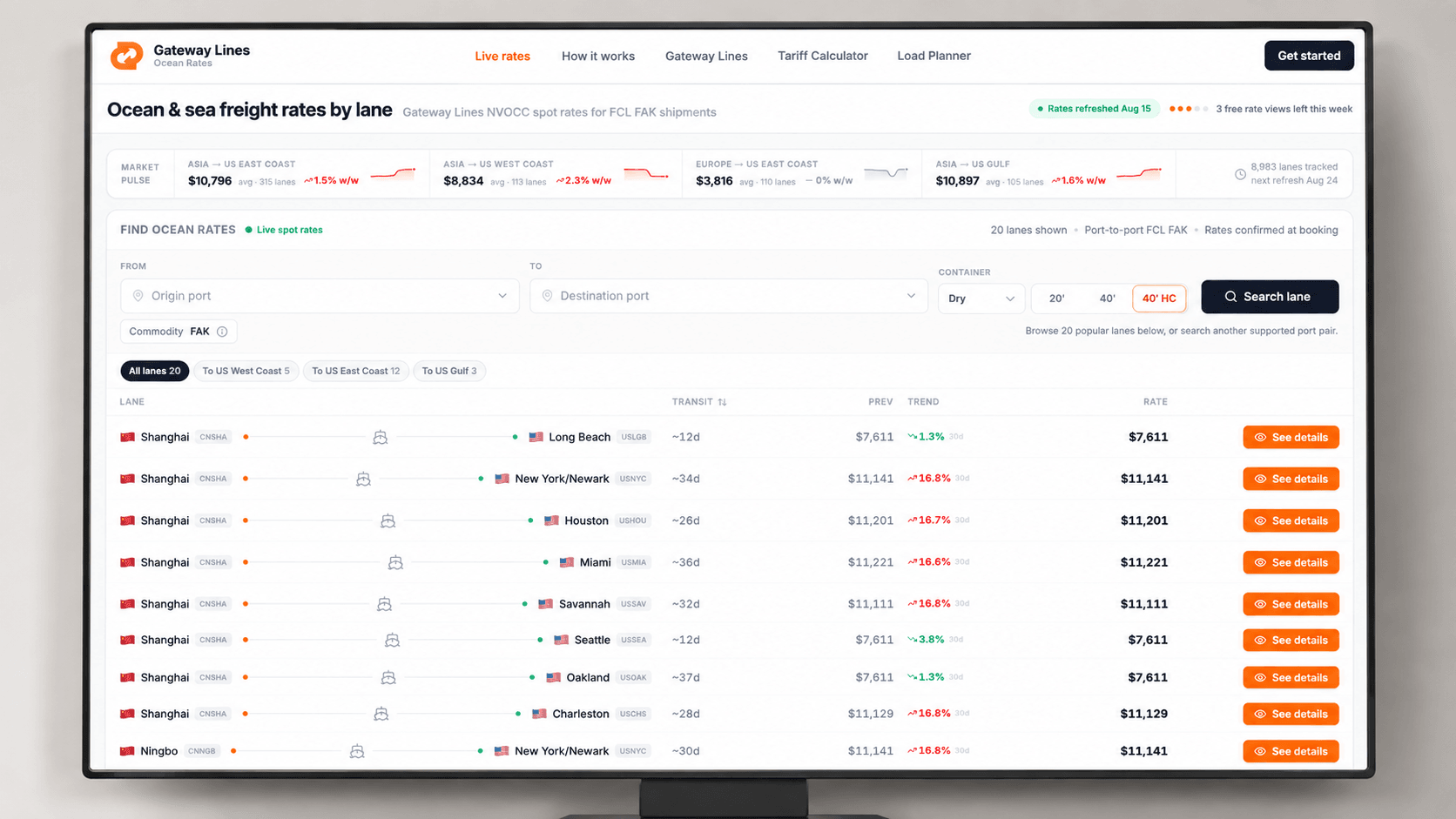
Last week, the spot rate from Shanghai to New York moved 10% in seven days.
If you emailed three forwarders for a quote on Monday, the numbers that landed in your inbox Wednesday were already stale. That's not a hypothetical — that's the market right now.
Our ocean freight spot rates are published on a public board. No account. No sales call. No "a specialist will reach out within one business day." You open the page, you see the rate, you book it.
What the market is actually doing right now
Ocean freight spot rates are climbing hard on the trans-Pacific, and capacity is being deliberately squeezed.
As of the August 13 assessment, the Drewry World Container Index sits at $4,339 per 40ft container, up 1% on the week, with the increase driven by the trans-Pacific. Underneath that headline number, the lane-level moves are much sharper:
Shanghai → New York: $8,706 per 40ft, up 10% in a single week
Shanghai → Los Angeles: $6,244 per 40ft, up 6% on the week
SCFI Shanghai → US East Coast: $9,568 per 40ft, up 19% over three weeks and the highest reading since July 2024
China → US West Coast: $6,714, up 21% over the same stretch
The reason is capacity, not demand. Carriers are pulling sailings off the board to hold rates up. Ten sailings were cancelled in each of the past two weeks, with more scheduled. Across the major East–West trades, 49 blank sailings are expected between week 34 and week 38 — roughly a 7% cancellation rate — with the heaviest concentration falling between August 31 and September 6.
There are Panama Canal surcharges layered on top, which carriers have imposed with little published justification.
Here's what that means for you as an importer: the number changes weekly, and the space is getting tighter. Every day you spend waiting on a quote is a day the rate can move against you and a day the sailing you wanted gets cancelled.
Why the quote-request model is broken
The standard way to buy ocean freight looks like this:
You fill out a form.
A salesperson calls you to "understand your needs."
Two days later you get a PDF with a number on it.
The number has an expiration date and probably a footnote about subject-to-space.
You repeat this with two more forwarders to see if you're being taken.
That process exists to protect margin, not to serve you. When rates are hidden, the quote you receive depends on how much the person on the other end thinks you know. A shipper moving four containers a year and a shipper moving four hundred get quoted the same lane at wildly different numbers — and neither one can tell.
In a market moving 10% a week, it's worse than unfair. It's operationally useless. By the time you've collected three comparable quotes, the market has repriced and you're comparing three different weeks.
What we do instead
We keep our spot market open to the public.
The rate board covers 20 trans-Pacific lanes with live pricing. Anyone can see it — customers, prospects, competitors, anyone. We're an FMC-licensed NVOCC and ocean freight forwarder, and we made the deliberate decision that our pricing should be as visible as our license.
No signup wall. You don't trade an email address for a number.
No sales gate. Nobody calls you to qualify you before you're allowed to know what shipping costs.
All-in, not teaser pricing. Our import fee structure is published alongside the rate: bill of lading $50, AMS filing $35, platform fee $25 — $110 total. Add customs coordination at $75 and it's $185. That's the list. There's no arrival-notice fee, no documentation-handling fee, and no line item that appears for the first time on the invoice.
We can price this way because we don't extend credit and we don't carry receivables risk. Payment clears before your cargo loads. That discipline comes straight out of running a freight operation that reached seven figures a month before this one — the margin most forwarders build in to cover slow-paying customers and bad debt isn't in our number, because we don't have that exposure.
Want a better rate than what's on the board?
The public board is our spot rate. It's honest, it's live, and it's competitive. But it is not the best number we can do.
Call us. In most cases we can be considerably more aggressive than the published spot rate, particularly on:
Dedicated volume. Committed monthly TEU on a defined lane gives us room to work carrier allocations rather than buying at spot ourselves.
Consistent lanes. Repeat, predictable moves on the same origin–destination pair are worth more to a carrier than one-off bookings, and that value flows back to you.
Flexible sailing windows. If you can move a week either direction, we can put you on the sailing where space is cheap instead of the one where it isn't.
Full-container programs. Multi-container bookings on the same lane price differently than singles.
Nothing about that requires you to start blind. Look at the board first, understand what the lane costs, then call us knowing exactly what you're negotiating from. That's the whole point of publishing it.
We work directly with importers and exporters — the companies whose cargo it actually is. Direct relationships are why the pricing works.
Frequently asked questions
Do I need an account to see your ocean freight rates? No. The rate board is public. No email, no login, no sales call. Open the page and the rates are there.
How current are the published spot rates? The board reflects live spot-market pricing across 20 trans-Pacific lanes. Given that lane rates have moved 6–10% in a single week this month, check the board on the day you're booking rather than working from a number you saved last week.
Are the published rates all-in, or do fees get added later? The import fee structure is published: $110 total for bill of lading, AMS filing, and platform fee combined, or $185 with customs coordination included. There are no fees introduced at invoice time.
Can I get a lower rate than what's published? In most cases, yes. Dedicated volume, consistent lane commitments, and flexible sailing windows all give us room to price more aggressively. Contact us with your lane and monthly volume.
Why are trans-Pacific rates rising in August 2026? Carriers are managing capacity through blank sailings — approximately 49 cancelled sailings across major East–West trades between mid-August and mid-September, a 7% cancellation rate. Reduced capacity against steady demand pushes spot rates up, and Panama Canal surcharges add further cost.
What's the difference between a spot rate and a contract rate? A spot rate is today's market price for a single booking and moves weekly. A contract rate is a negotiated price held over a defined period in exchange for committed volume. When spot rates are climbing the way they are now, shippers with contract coverage are insulated — which is exactly why it's worth having the volume conversation before the next increase lands.
Do you work with freight forwarders or overseas agents? No. We work directly with beneficial cargo owners — the importers and exporters moving their own freight.
See the rate before you call
Rates moved 10% last week on the Shanghai–New York lane. They'll move again this week. The blank sailing schedule tightens through early September.
You can spend two days collecting quotes that expire before you compare them, or you can open the board and see the number right now.
View live ocean freight spot rates →
Moving cargo with volume behind it? Contact us with your lane and monthly TEU and we'll price it properly.
Related tools: Tariff simulator for landed-cost and duty calculations across 30,000+ HTS codes, and the 3D container load planner for cargo fit and stowage.
Rate data referenced from Drewry World Container Index (August 13, 2026 assessment) and Shanghai Containerized Freight Index. Market conditions change weekly.