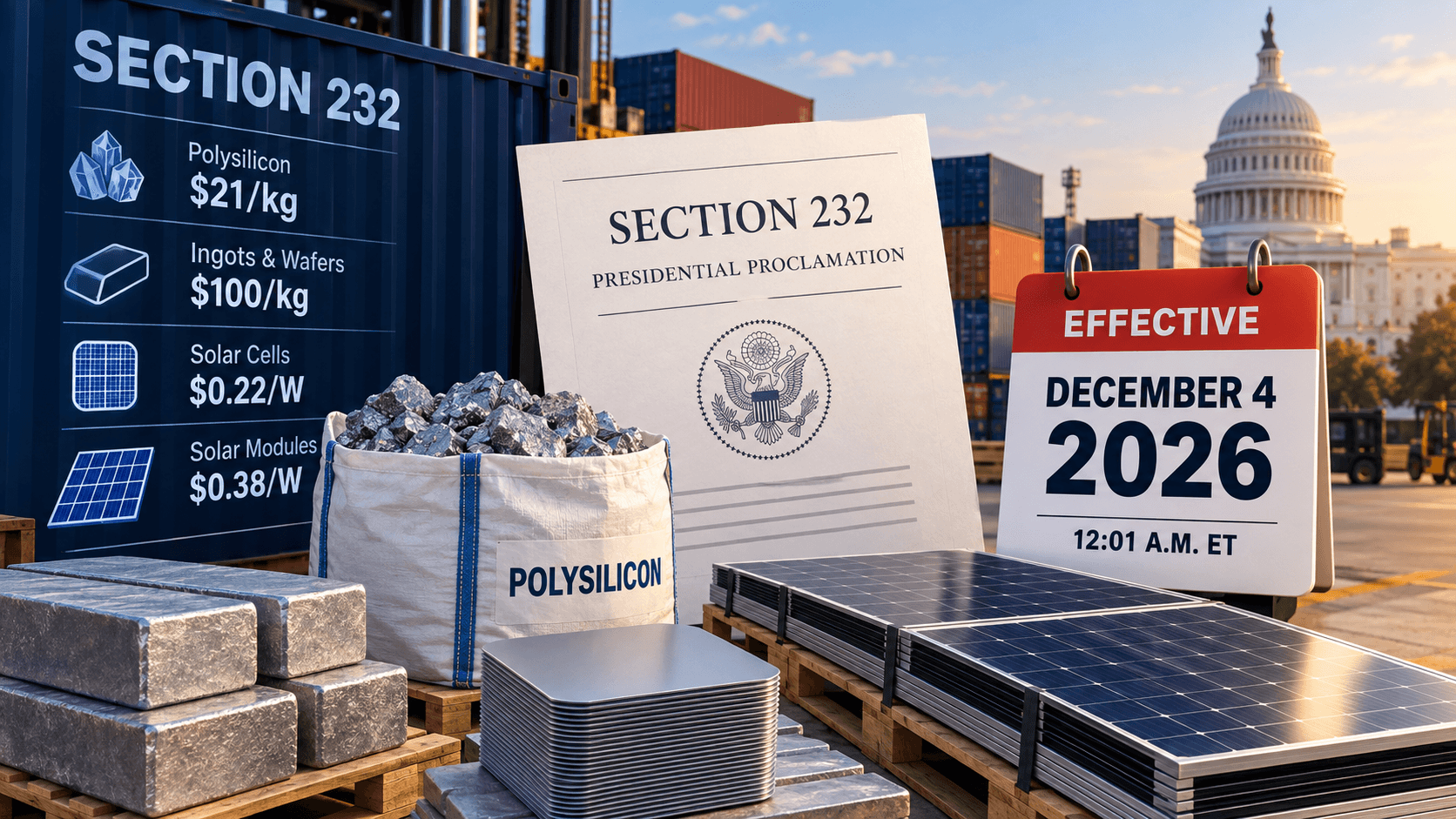
New U.S. Section 232 polysilicon tariffs take effect at 12:01 a.m. Eastern Time on December 4, 2026, affecting covered polysilicon, ingots, wafers, solar cells, and modules. Importers, solar developers, and distributors face minimum import prices, an added derivative duty, and strict documentation requirements. Check the Gateway Tariff Radar
Key facts at a glance
Authority: Section 232 proclamation signed August 6 and published August 11, 2026.
Effective: December 4, 2026, at 12:01 a.m. ET, for consumption entries and withdrawals.
Minimum prices: $21/kg polysilicon; $100/kg ingots and wafers; $0.22/W cells; $0.38/W modules.
Additional duty: 15% ad valorem on covered polysilicon ingots and derivatives, subject to exceptions.
Risk: Materially inaccurate documentation can permanently bar the importer and affiliates.
Implementation: CBP has not yet published implementing guidance.
What's changing on December 4: polysilicon tariffs
The proclamation creates a minimum import price (MIP) program and an additional Section 232 duty for specified goods. Both measures apply to consumption entries and withdrawals beginning at the effective time.
A purchase agreement or shipping date does not determine applicability. Establish the expected entry date and confirm product classification, value, and documentation.
These solar tariffs 2026 measures are distinct from existing trade remedies.
Which products are covered
The proclamation identifies covered merchandise through Annexes I and II. The product categories and minimum import prices are:
Product | Minimum import price |
|---|---|
Polysilicon | $21 per kilogram |
Polysilicon ingots and wafers | $100 per kilogram |
Solar cells | $0.22 per watt |
Solar modules | $0.38 per watt |
Not all solar equipment is covered. Match the product description and U.S. tariff classification to the annexes. Research classifications using the Gateway Lines HS code search, then verify coverage.
How minimum import prices work
A minimum import price is not simply another percentage duty. Under the proclamation, an importer may submit documentation at entry establishing or certifying that the first arm's-length U.S. sale of the imported merchandise, or applicable downstream product, will be at or above the relevant MIP. There is also a documentation route for an imported product sold under fixed terms in a contract signed before August 6, 2026.
With qualifying documentation, an entered customs value below MIP triggers a specific tariff equal to the shortfall. Without it, the specific tariff equals the full MIP.
Illustration only — solar modules: Assume a covered module has an entered value of $0.22/W, and the importer properly certifies a first arm's-length U.S. sale at $0.38/W. The gap between the entered value and the $0.38/W module MIP is $0.16/W, so the MIP-based specific tariff is $0.16/W. With no qualifying documentation, that specific tariff would instead be $0.38/W. This does not include other applicable duties.
The extra 15% duty
The proclamation also imposes an additional 15% ad valorem duty on covered polysilicon ingots and polysilicon derivatives listed in Annexes I and II, except where the proclamation specifies different treatment.
Ad valorem means the duty is calculated as a percentage of the applicable customs value. It is separate from the MIP-based specific tariff. A covered import may therefore require both calculations. Importers should not automatically apply this additional duty to raw polysilicon without checking the actual product coverage.
Documentation and the permanent-ban risk
The documentation requirement is a central compliance issue, not an administrative formality. Importers must be able to support the certification about the first arm's-length U.S. sale or the qualifying pre-proclamation fixed-terms contract.
CBP is directed to monitor accuracy. If CBP determines that an importer's documentation was materially inaccurate, or that the importer materially failed to comply with its certification, the importer and its affiliates face a permanent prohibition on importing polysilicon and its derivatives into the United States.
Maintain the signed contracts, sales documentation, entered-value support, and records connecting the imported goods to the certified transaction. CBP implementing guidance has not yet been published, so filing mechanics should not be assumed.
Country caps
Special country treatment applies to covered products from Japan, Korea, Taiwan, Switzerland, Liechtenstein, and the European Union. These provisions affect the interaction of the additional Section 232 duty and the applicable ordinary tariff rate; they are not a reason to skip product classification or MIP review.
Origin, the relevant tariff line, and the specific exception all matter. See the proclamation for exact terms rather than assuming one treatment applies to every supplier in those jurisdictions.
How it stacks with Section 301 and other duties
Unless an exception applies, the Section 232 measures add to other duties, taxes, fees, and charges. Landed-cost estimates must account for the MIP-specific tariff, additional ad valorem duty, and origin-dependent duties.
A separate, near-term deadline concerns 14 Section 301 exclusions for solar manufacturing equipment, claimed under 9903.88.70. They are scheduled to expire November 9, 2026, unless extended. These equipment exclusions are separate from the new MIPs.
Review the Section 301 exclusion list and use the Gateway Lines tariff calculator for planning, while recognizing that the new MIP filing procedures await CBP guidance.
Key dates timeline
August 6, 2026: Section 232 proclamation signed.
August 11, 2026: Published in the Federal Register as document 2026-16400.
November 9, 2026: Scheduled expiration of the 14 solar manufacturing equipment Section 301 exclusions, unless extended.
December 4, 2026, 12:01 a.m. ET: New MIP program and additional covered-product duty take effect for consumption entries and withdrawals.
What importers should do now
Map products to coverage. Confirm descriptions, classification, and whether Annex I or II applies.
Identify the right unit. Use kilograms for polysilicon, ingots, and wafers; watts for cells and modules.
Review entry timing. Flag shipments likely to enter or be withdrawn for consumption on or after December 4.
Test MIP exposure. Compare entered values with applicable thresholds and account separately for the additional 15% duty where applicable.
Validate sale certifications. Confirm the first arm's-length U.S. sale and preserve any qualifying fixed-terms contracts.
Screen other duties. Review origin-based treatment, Section 301 obligations, and the November 9 exclusion deadline.
Monitor CBP instructions. Reconcile entry procedures once implementing guidance is published.
Frequently asked questions
When do the new polysilicon tariffs take effect?
The Section 232 measures begin at 12:01 a.m. Eastern Time on December 4, 2026. They apply to covered merchandise entered for consumption or withdrawn from a customs warehouse for consumption at or after that time. Importers should review the actual entry timing, not rely only on the purchase or shipping date.
What is the minimum import price for solar modules in 2026?
The proclamation sets the solar module minimum import price at $0.38 per watt. It also establishes $0.22 per watt for solar cells, $100 per kilogram for ingots and wafers, and $21 per kilogram for polysilicon. Classification and documentation determine how these thresholds affect a particular entry.
Does the 15% Section 232 duty apply to raw polysilicon?
The proclamation states that the additional 15% ad valorem duty applies to covered polysilicon ingots and derivatives identified in Annexes I and II, subject to specified exceptions. Do not assume the same duty automatically applies to raw polysilicon. Verify the specific covered product and applicable tariff provisions before calculating exposure.
How is the solar module import tariff calculated below the minimum price?
When the importer submits qualifying documentation and the entered value is below the module minimum import price, the specific tariff equals the difference. Without the required documentation, the specific tariff equals the full minimum import price. Any separate additional ad valorem duty must also be evaluated under the proclamation.
What happens if I do not submit minimum import price documentation?
For a covered import, failing to submit the specified certification or supporting documentation triggers a specific tariff equal to the entire applicable minimum import price, rather than just the difference between the entered value and that price. Importers should prepare their records before entry and monitor forthcoming CBP implementation instructions.
Can a contract signed before August 6, 2026 qualify?
The proclamation provides a documentation route for the first arm's-length U.S. sale of imported merchandise under fixed terms in a contract entered into before the proclamation was signed on August 6, 2026. Importers should retain the signed agreement and related evidence. The precise CBP filing instructions have not yet been published.
Do Section 232 solar tariffs replace Section 301 duties?
No. The proclamation says its measures apply in addition to other applicable duties unless a specific exception provides otherwise. Section 301 duties or exclusions require their own analysis. Separately, the 14 solar manufacturing equipment exclusions claimed under 9903.88.70 are scheduled to expire November 9, 2026, unless extended.
Which solar HTS codes are covered by the new tariffs?
Coverage is determined by the merchandise identified in Annexes I and II, not by a generic description such as solar equipment. Review the covered HTS codes against the product's actual classification and description. Gateway Lines provides a dedicated tracker, while final treatment should be confirmed against the proclamation and CBP guidance when issued.
Conclusion
The December 4 polysilicon tariffs require accurate solar HTS codes, MIP certification support, and a review of other duties. Use the Gateway Lines covered-product tracker and tariff calculator to prepare your estimates, then coordinate documentation and final entry treatment with your customs broker.
Official sources: White House proclamation and Federal Register document 2026-16400.
This article is for general information and is not legal advice.