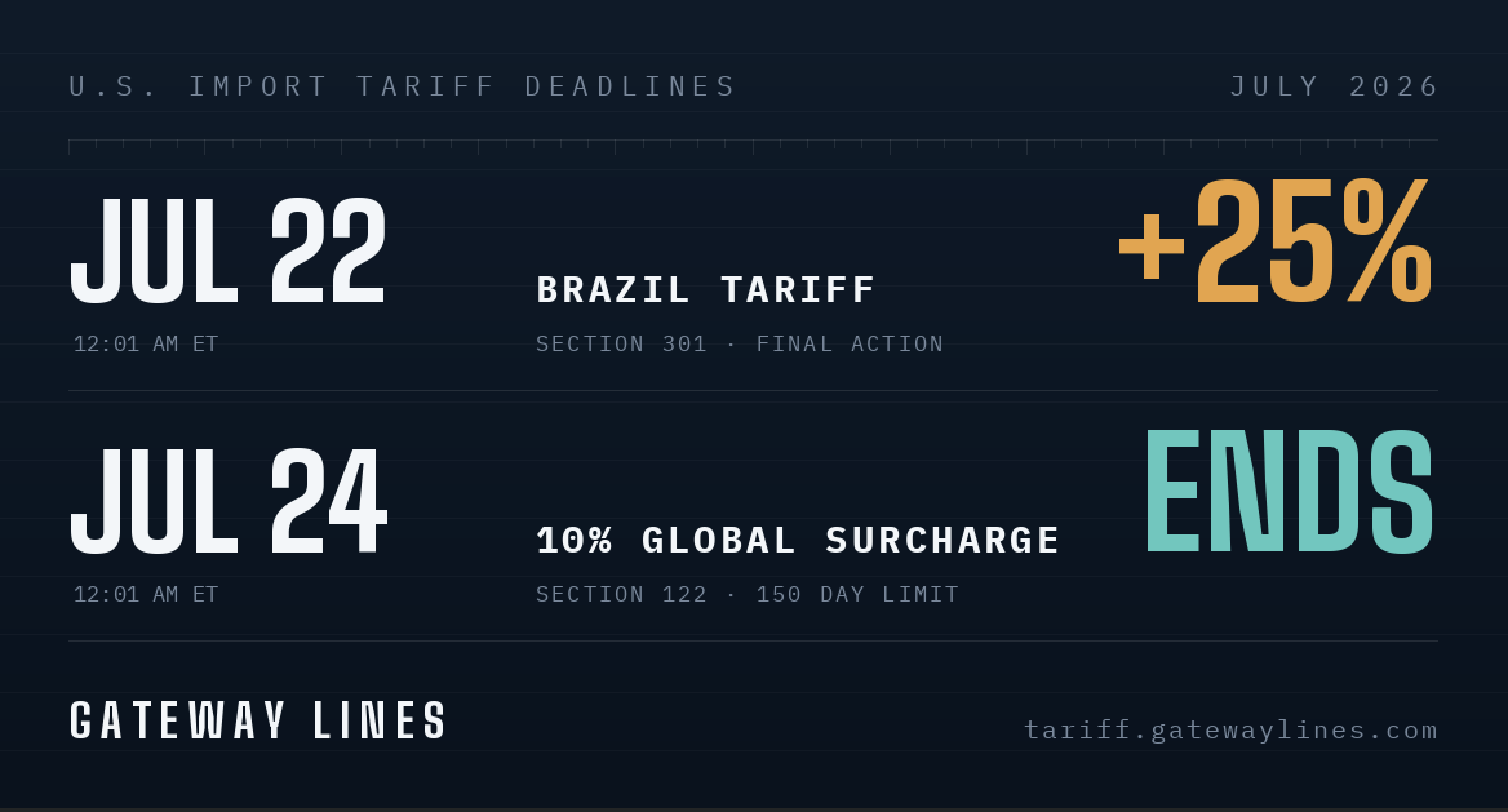
Two dates this month change what importers pay at the border, and they land 48 hours apart. On July 22, a new 25% tariff on most goods from Brazil takes effect. On July 24, the 10% global import surcharge that has applied to nearly every US import since February expires by operation of law.
If you have cargo on the water right now, one thing decides which rules you pay under: the entry date on your customs filing. Not the sail date, not the invoice date, not the day the vessel arrives. Here is what is ending, what is starting, and what to check this week.
Key dates
Date | What happens |
|---|---|
July 20 | US and Mexico resume USMCA joint review talks (Round 3, Mexico City) |
July 22, 12:01 a.m. ET | 25% Section 301 tariff on most Brazilian-origin goods takes effect, based on entry date |
July 24, 12:01 a.m. EDT | 10% Section 122 global surcharge expires; entries on or after this time are not subject to it |
July 29, 12:01 a.m. ET | Brazil in-transit window closes: cargo loaded before July 22 must be entered before this time to stay exempt |
July 31 | 100% Section 232 tariff on patented pharmaceuticals begins for larger companies (September 29 for others) |
What the Section 122 surcharge is, and why it ends automatically
In February 2026, after the Supreme Court struck down the tariffs that had been imposed under IEEPA, the White House invoked Section 122 of the Trade Act of 1974 and imposed a 10% surcharge on imports from all countries. It took effect February 24, 2026 under Proclamation 11012, with CBP collecting it under HTSUS heading 9903.03.01.
Two features of Section 122 make July 24 a hard deadline. The statute caps a balance of payments surcharge at 15% ad valorem, and it caps the duration at 150 days unless Congress votes to extend it. The rate actually imposed was 10%. A 15% figure was floated publicly in February, but no proclamation ever implemented it, so 10% is the number that has appeared on every entry. The 150-day clock started February 24 and runs out at 12:01 a.m. Eastern on July 24, 2026. Congress has not extended it, so the surcharge ends on its own terms.
The main exemptions during the 150-day window have been goods that qualify under USMCA, articles already covered by Section 232 tariffs (which do not stack with the surcharge), certain CAFTA-DR textiles, Chapter 98 entries, and a product-specific list in the proclamation's annexes.
The cutoff is the entry date, not the arrival date
CBP's guidance applies the surcharge to goods entered for consumption, or withdrawn from a bonded warehouse for consumption, through 12:01 a.m. EDT on July 24. Entries filed before that moment include the 10%. Entries on or after it do not.
That is why two identical containers on the same lane can carry different duty bills. A shipment entered July 22 pays the surcharge. The same goods entered July 25 do not. For cargo arriving close to the deadline, the timing of the consumption entry is worth a direct conversation with your customs broker, and the same logic applies to goods sitting in a bonded warehouse, since duties are assessed at withdrawal rather than at arrival.
Three things the expiration does not do. It does not refund duties already paid: the sunset is forward looking, and amounts properly collected between February 24 and July 23 are not returned because the program ended. It does not resolve the court fight: the Court of International Trade ruled against the surcharge in May, the government appealed, and CBP has kept collecting under a stay while the appeal proceeds.
Importers who want to preserve potential rights on past entries should raise it with their broker or trade counsel promptly, because protest deadlines run from liquidation. And it does not restore anything else that changed this year: measures imposed under other authorities are unaffected.
One recovery path does exist regardless of the litigation. Duty drawback is available for Section 122 duties, so importers who re-export or destroy merchandise can recover up to 99% of what they paid under standard drawback rules.
Two days earlier, Brazil gets a 25% tariff
On July 15, USTR took final action in its Section 301 investigation of Brazil and imposed a 25% tariff on Brazilian-origin goods, with exemptions. It applies to goods entered for consumption, or withdrawn from warehouse for consumption, on or after 12:01 a.m. ET on July 22, 2026, under new HTSUS heading 9903.05.01.
There is a narrow in-transit exception that matters for ocean freight. Goods that were loaded on a vessel and in transit on the final mode before 12:01 a.m. ET July 22, and that are entered before 12:01 a.m. ET July 29, stay exempt. If you have Brazilian cargo already sailing, keep the load date documentation clean and make sure your broker files within that window. Missing the July 29 entry cutoff puts otherwise exempt cargo into the 25%.
The exemption list is long but product specific. Articles already subject to Section 232 tariffs (steel, aluminum, copper, vehicles, wood products, semiconductors) are excluded, along with civil aircraft, articles for pharmaceutical use, donations, informational materials, and a lengthy annex covering products such as coffee, cocoa, orange juice, beef, iron ore, pig iron, and many raw materials.
Some categories are exempt only in part, so this comes down to your exact HTS lines, not the general product family. If you import anything of Brazilian origin, run your classifications against the annexes before your next booking.
One more wrinkle: for entries on July 22 and 23, the new Brazil tariff and the outgoing 10% surcharge can apply at the same time unless an exemption covers the goods. If you have Brazilian cargo landing in exactly that window, entry timing is worth a hard look.
The rest of July is not quiet either
The surcharge ending is not the same as tariffs ending. In June, USTR issued findings in 60 separate Section 301 investigations tied to forced-labor enforcement and proposed additional duties of 10% to 12.5%. Hearings were held July 7 and the record is closed, so final action could come at any time, and unlike Section 122, a Section 301 action carries no 150-day clock. The US declined to renew USMCA at the July 1 joint review, though the agreement and its preferential treatment remain in force while talks continue, with the next round starting the week of July 20. And a 100% Section 232 tariff on patented pharmaceuticals begins July 31 for larger companies.
Update, October 2026: That action took effect on July 24, 2026, the same day the surcharge expired: a Section 301 forced labor tariff of 10% or 12.5% on goods from 60 economies. Our guide to the Section 301 forced labor tariffs lists the rate for every economy, the exemptions and worked examples.
So whether your landed cost actually falls after July 24 depends on your origin, your HTS lines, and what gets finalized next. Plan against scenarios, not against a single date.
What to check this week
Pull your open bookings and map ETAs against entry dates around July 22 and July 24, because a few days of timing can move real money in either direction. Ask your broker how entries near the July 24 cutoff will be handled, including anything sitting in bond. If you touch Brazil, confirm on-board dates for the in-transit exemption, calendar the July 29 filing deadline, and check your HTS lines against the exemption annexes. Then model your post-July numbers under more than one scenario, including a possible 10% to 12.5% action under the forced-labor investigations, so a new tariff does not show up as a surprise on an invoice.
You can run those numbers in our free US Import Tariff Calculator, which reflects official policy actions within 24 to 48 hours of publication and tracks every change in our policy log, monitored against the Federal Register, White House releases, USTR, and USITC.
Gateway Lines is an FMC-licensed NVOCC and ocean freight forwarder. If you want a second set of eyes on landed cost for an upcoming shipment, or a quote that already accounts for the post-July 24 tariff picture, reach out here.
This article is general information for import planning, not legal or customs advice. Tariff treatment depends on classification, origin, entry timing, and the guidance in force when goods enter. Work with your licensed customs broker on specific entries.