Since 12:01 a.m. ET on July 24, 2026, products of 60 economies pay an additional Section 301 duty of 10% or 12.5%. USTR imposed it because each economy failed to impose and effectively enforce a ban on imports made with forced labor.
Key figures
The duty is 10% or 12.5% on most goods from 60 economies, collected on entries since July 24, 2026.
Item | Detail |
|---|---|
Additional duty | 10% or 12.5% ad valorem on top of the MFN rate; capped net of MFN for 5 economies |
Economies covered | 60: 19 in the 10% tier, 41 in the 12.5% tier |
In effect from | 12:01 a.m. ET, July 24, 2026, for goods entered or withdrawn from warehouse for consumption |
Legal authority | Sections 301(b), 301(c) and 304(a) of the Trade Act of 1974 |
Federal Register | USTR notice of action, 91 FR 47318 (FR Doc. 2026-15181, July 28, 2026) |
CBP filing guidance | CSMS #69326983, issued July 23, 2026 |
Chapter 99 headings | 9903.05.20 to 9903.05.84 (rates); 9903.05.85 to 9903.05.92 (general exemptions); 9903.05.93 to 9903.06.21 (economy-specific exemptions) |
Not charged on | Goods under Section 232 duties: steel, aluminum and copper articles; cars, light trucks and parts; medium- and heavy-duty vehicles and parts; wood products; semiconductors |
Still charged on top | Antidumping and countervailing duties, and other Section 301 actions such as those on China and Brazil |
What it replaced | The temporary 10% Section 122 surcharge, which expired July 24, 2026 |
Who pays what
China, Vietnam and 36 other economies pay a flat 12.5%, while Canada, Mexico, India, the UK and 13 others pay 10%.
Products of China pay an additional 12.5% Section 301 forced labor duty, on top of existing Section 301 China tariffs.
Products of Canada and Mexico pay 10%, except goods entered duty-free under USMCA.
For the EU and Taiwan, the MFN rate plus the new duty is capped at 10%; for Japan, South Korea and Switzerland, at 12.5%.
Tier | How it applies | Economies | Count |
|---|---|---|---|
12.5% | Added on top of the MFN rate | Algeria, Angola, Australia, the Bahamas, Bahrain, Brazil, Chile, China, Colombia, Costa Rica, Dominican Republic, Egypt, Guyana, Hong Kong, Iraq, Israel, Kazakhstan, Kuwait, Libya, Morocco, New Zealand, Nicaragua, Nigeria, Norway, Oman, Peru, the Philippines, Qatar, Russia, Saudi Arabia, Singapore, South Africa, Thailand, Türkiye, United Arab Emirates, Uruguay, Venezuela, Vietnam | 38 |
12.5% net of MFN | MFN plus Section 301 totals 12.5%; zero when MFN is 12.5% or more | Japan, South Korea, Switzerland | 3 |
10% | Added on top of the MFN rate | Argentina, Bangladesh, Cambodia, Canada, Ecuador, El Salvador, Guatemala, Honduras, India, Indonesia, Jordan, Malaysia, Mexico, Pakistan, Sri Lanka, Trinidad and Tobago, United Kingdom | 17 |
10% net of MFN | MFN plus Section 301 totals 10%; zero when MFN is 10% or more | European Union (all member states), Taiwan | 2 |
The 10% tier is for economies that ban forced labor imports, committed to a ban in an Agreement on Reciprocal Trade, or block some forced labor goods. Six economies adopted bans after USTR's June 5 proposal: Cambodia, Guatemala, Honduras, India, Sri Lanka, and Trinidad and Tobago. Jordan committed to one in its trade agreement, and all seven sit in the 10% tier.
Goods from economies outside these 60 do not pay this duty.
At a glance
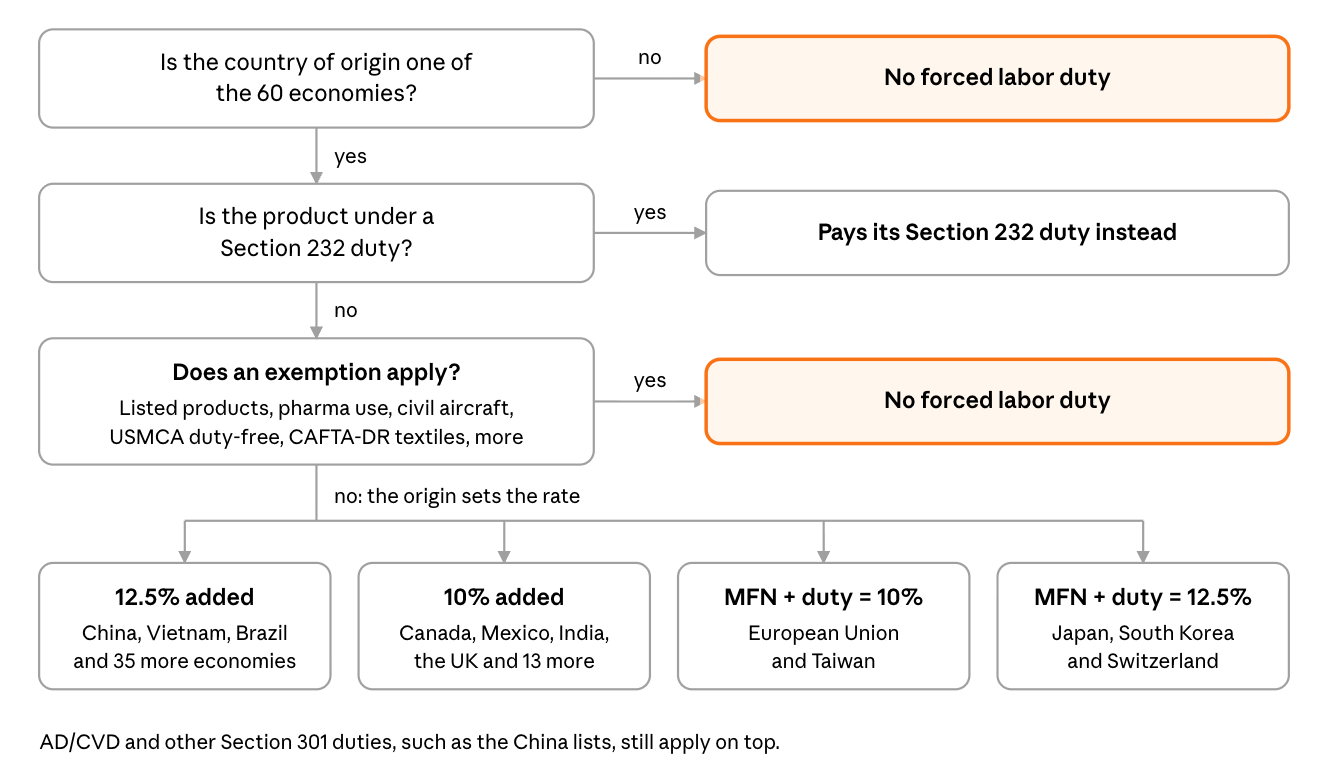
A shipment from one of the 60 economies that is not under Section 232 and not exempt pays the rate set by its origin.
The net-of-MFN cap
For the EU, Taiwan, Japan, South Korea and Switzerland, the new duty only tops the MFN rate up to a ceiling, so a product whose MFN rate already meets it pays no forced labor duty.
Section 301 duty = cap minus the MFN rate, never below zero.
The cap is 10% for the EU and Taiwan and 12.5% for Japan, South Korea and Switzerland. For a per-unit MFN rate, CBP compares its ad valorem equivalent.
Origin | MFN rate (illustrative) | Cap | Section 301 duty | Total |
|---|---|---|---|---|
Germany (EU) | 2.5% | 10% | 7.5% | 10% |
Italy (EU) | 12% | 10% | 0% | 12% |
Taiwan | 0% | 10% | 10% | 10% |
Japan | 3% | 12.5% | 9.5% | 12.5% |
South Korea | 0% | 12.5% | 12.5% | 12.5% |
Switzerland | 15% | 12.5% | 0% | 15% |
Each economy has two Chapter 99 headings: one for products at or above the cap (no duty) and one for products below it (combined rate).
What is exempt
Goods already under Section 232 duties, USMCA goods entered duty-free from Canada and Mexico, and a long list of raw materials and other products do not pay the duty.
Exemption | Heading | What it covers |
|---|---|---|
Section 232 goods | 9903.05.90 | Steel, aluminum and copper articles and steel or aluminum derivatives; cars, light trucks and parts; medium- and heavy-duty vehicles and parts; wood products; semiconductors |
Listed products | 9903.05.86, 9903.05.87 | Products in U.S. note 52(b) and (c), such as raw materials and goods the U.S. cannot produce in enough volume |
Pharmaceutical use | 9903.05.89 | Articles for use in pharmaceutical applications |
Civil aircraft | 9903.05.88 | Civil aircraft, engines, parts, components and ground flight simulators |
Donations | 9903.05.91 | Relief donations such as food, clothing and medicine |
Informational materials | 9903.05.92 | Publications, films, recordings, photographs, artworks and news wire feeds |
In transit (closed) | 9903.05.85 | Goods loaded before 12:01 a.m. ET July 24, 2026 and entered before 12:01 a.m. ET July 28, 2026 |
Chapter 98 entries | None needed | Most Chapter 98 entries; under 9802.00.40, .50, .60 and 9802.00.80 the duty applies to the value of foreign repairs, processing or assembly |
USMCA goods | 9903.05.93 (Canada), 9903.05.94 (Mexico) | Products of Canada or Mexico entered free of duty under USMCA |
CAFTA-DR textiles | 9903.05.95 | Textiles and apparel of Costa Rica, the Dominican Republic, El Salvador, Guatemala, Honduras and Nicaragua entered duty-free under CAFTA-DR |
Negotiated product lists | 9903.05.96 to 9903.06.21 | Specific products of the UK, EU, Switzerland, Malaysia, Cambodia, Guatemala, El Salvador, Argentina, Bangladesh, Taiwan, Indonesia, Ecuador and Jordan |
Product exemptions work by HTS code, so check yours against CBP's Forced Labor HTS List. USTR's final action added 471 products to the list, kept coffee on it, and kept beef, avocados and paprika despite requests to remove them. Certain chemicals are exempt only when used in pharmaceuticals.
Foreign trade zones: covered goods must enter a zone in privileged foreign status, so a zone does not avoid the duty.
Textile quotas: USTR will set three-year tariff-rate quotas letting a volume of textiles and apparel from Bangladesh, Cambodia, Indonesia and Malaysia enter free of this duty, sized to their purchases of U.S. cotton and textile inputs. Until each quota is announced in the Federal Register, the 10% applies.
How it stacks with other duties
The forced labor duty adds to the MFN rate, other Section 301 actions and AD/CVD, but never lands on goods under Section 232.
China: goods on Section 301 Lists 1 to 4A pay their list rate plus the new 12.5%.
Brazil: most Brazilian products also pay a separate 25% Section 301 duty (heading 9903.05.01) in effect since July 22, 2026.
Canada: listed Canadian products also pay a separate 50% Section 338 duty in effect since August 22, 2026, and USMCA status does not exempt them from it.
Section 232: goods under Section 232 pay that duty instead; the forced labor duty does not apply.
AD/CVD: antidumping and countervailing duties still apply in full.
Section 122: the temporary 10% surcharge expired July 24, 2026 and is no longer collected.
IEEPA: the Supreme Court struck down the reciprocal and fentanyl tariffs in February 2026; duties paid under them may be refundable (estimate yours).
On the entry summary, CBP wants Chapter 98 first, then Chapter 99 headings with Section 301 ahead of Section 122, Section 232 and Section 201, then the Chapter 1 to 97 code.
Worked examples
On a $100,000 shipment, the forced labor layer alone adds up to $12,500, and Chinese or Brazilian goods can owe about $40,000 once other Section 301 duties stack.
Shipment, $100,000 entered value | MFN rate | Other additional duty | Forced labor duty | Total rate | Duty owed |
|---|---|---|---|---|---|
China, product on Section 301 List 3 | 3% | 25% (Section 301 China) | 12.5% | 40.5% | $40,500 |
Brazil, not on an exemption list | 2% | 25% (Section 301 Brazil) | 12.5% | 39.5% | $39,500 |
Vietnam, not on an exemption list | 4% | None | 12.5% | 16.5% | $16,500 |
India, not on an exemption list | 6% | None | 10% | 16% | $16,000 |
Germany (EU), low-MFN product | 2.5% | None | 7.5% (10% cap) | 10% | $10,000 |
Mexico, entered duty-free under USMCA | 0% | None | 0% | 0% | $0 |
MFN rates here are illustrative, and totals exclude merchandise processing and harbor maintenance fees. A non-USMCA Mexican product pays 10% on top of its MFN rate. A steel, aluminum, copper, auto, truck, wood or semiconductor product from any of the 60 pays its Section 232 rate instead.
Run your own HTS code and origin through Gateway's free tariff calculator, which applies the forced labor layer, the net-of-MFN caps and the exemptions.
Timeline
The action went from investigation to collection in 134 days, timed to replace the expiring Section 122 surcharge.
Date | Event |
|---|---|
July 28, 2026 | In-transit window closes at 12:01 a.m. ET; the notice is published at 91 FR 47318 |
July 24, 2026 | Duties take effect at 12:01 a.m. ET; the Section 122 surcharge expires |
July 23, 2026 | Presidential memorandum sets final rates; USTR announces final action; CBP issues CSMS #69326983 |
July 7 to 9, 2026 | Public hearing on the proposed action; over 100 witnesses and over 1,600 written comments |
June 5, 2026 | Proposed 10% and 12.5% tariffs published at 91 FR 34272 |
June 2, 2026 | USTR finds the practices of all 60 economies actionable |
April 28 to 29, 2026 | First public hearings |
March 12, 2026 | USTR opens 60 investigations, published at 91 FR 12884 on March 17 |
February 2026 | Supreme Court rules the IEEPA tariffs unlawful; a temporary 10% Section 122 surcharge replaces them |
Full list: rate and Chapter 99 heading by economy
Each economy has its own Chapter 99 heading, and the five net-of-MFN economies have two. Every rate heading excludes the general exemptions, 9903.05.85 to 9903.05.92; a blank last cell means no economy-specific exemption.
Economy | Rate | Rate heading | Economy-specific exemption headings |
|---|---|---|---|
Algeria | 12.5% | 9903.05.20 | |
Angola | 12.5% | 9903.05.21 | |
Argentina | 10% | 9903.05.22 | 9903.06.10, 9903.06.11 |
Australia | 12.5% | 9903.05.23 | |
The Bahamas | 12.5% | 9903.05.24 | |
Bahrain | 12.5% | 9903.05.25 | |
Bangladesh | 10% | 9903.05.26 | 9903.06.12, 9903.06.13 |
Brazil | 12.5% | 9903.05.27 | |
Cambodia | 10% | 9903.05.28 | 9903.06.02, 9903.06.03 |
Canada | 10% | 9903.05.29 | 9903.05.93 (USMCA) |
Chile | 12.5% | 9903.05.30 | |
China | 12.5% | 9903.05.31 | |
Colombia | 12.5% | 9903.05.32 | |
Costa Rica | 12.5% | 9903.05.33 | 9903.05.95 (CAFTA-DR textiles) |
Dominican Republic | 12.5% | 9903.05.34 | 9903.05.95 (CAFTA-DR textiles) |
Ecuador | 10% | 9903.05.35 | 9903.06.18, 9903.06.19 |
Egypt | 12.5% | 9903.05.36 | |
El Salvador | 10% | 9903.05.37 | 9903.05.95; 9903.06.07 to 9903.06.09 |
European Union | 10% net of MFN | 9903.05.38 (MFN 10% or more, no duty); 9903.05.39 (MFN under 10%, combined 10%) | 9903.05.97 |
Guatemala | 10% | 9903.05.40 | 9903.05.95; 9903.06.04 to 9903.06.06 |
Guyana | 12.5% | 9903.05.41 | |
Honduras | 10% | 9903.05.42 | 9903.05.95 (CAFTA-DR textiles) |
Hong Kong | 12.5% | 9903.05.43 | |
India | 10% | 9903.05.44 | |
Indonesia | 10% | 9903.05.45 | 9903.06.16, 9903.06.17 |
Iraq | 12.5% | 9903.05.46 | |
Israel | 12.5% | 9903.05.47 | |
Japan | 12.5% net of MFN | 9903.05.48 (MFN 12.5% or more, no duty); 9903.05.49 (MFN under 12.5%, combined 12.5%) | |
Jordan | 10% | 9903.05.50 | 9903.06.20, 9903.06.21 |
Kazakhstan | 12.5% | 9903.05.51 | |
Kuwait | 12.5% | 9903.05.52 | |
Libya | 12.5% | 9903.05.53 | |
Malaysia | 10% | 9903.05.54 | 9903.05.99, 9903.06.01 |
Mexico | 10% | 9903.05.55 | 9903.05.94 (USMCA) |
Morocco | 12.5% | 9903.05.56 | |
New Zealand | 12.5% | 9903.05.57 | |
Nicaragua | 12.5% | 9903.05.58 | 9903.05.95 (CAFTA-DR textiles) |
Nigeria | 12.5% | 9903.05.59 | |
Norway | 12.5% | 9903.05.60 | |
Oman | 12.5% | 9903.05.61 | |
Pakistan | 10% | 9903.05.62 | |
Peru | 12.5% | 9903.05.63 | |
The Philippines | 12.5% | 9903.05.64 | |
Qatar | 12.5% | 9903.05.65 | |
Russia | 12.5% | 9903.05.66 | |
Saudi Arabia | 12.5% | 9903.05.67 | |
Singapore | 12.5% | 9903.05.68 | |
South Africa | 12.5% | 9903.05.69 | |
South Korea | 12.5% net of MFN | 9903.05.70 (MFN 12.5% or more, no duty); 9903.05.71 (MFN under 12.5%, combined 12.5%) | |
Sri Lanka | 10% | 9903.05.72 | |
Switzerland | 12.5% net of MFN | 9903.05.73 (MFN 12.5% or more, no duty); 9903.05.74 (MFN under 12.5%, combined 12.5%) | 9903.05.98 |
Taiwan | 10% net of MFN | 9903.05.75 (MFN 10% or more, no duty); 9903.05.76 (MFN under 10%, combined 10%) | 9903.06.14, 9903.06.15 |
Thailand | 12.5% | 9903.05.77 | |
Trinidad and Tobago | 10% | 9903.05.78 | |
Türkiye | 12.5% | 9903.05.79 | |
United Arab Emirates | 12.5% | 9903.05.80 | |
United Kingdom | 10% | 9903.05.81 | 9903.05.96 |
Uruguay | 12.5% | 9903.05.82 | |
Venezuela | 12.5% | 9903.05.83 | |
Vietnam | 12.5% | 9903.05.84 |
Source: CBP CSMS #69326983.
FAQ
What is the Section 301 forced labor tariff?
It is an additional 10% or 12.5% duty on most goods from 60 economies, in effect since July 24, 2026. USTR found each economy fails to impose and effectively enforce a ban on imports made with forced labor.
Does it apply to goods from China?
Yes. Most Chinese products pay 12.5%, added to any Section 301 List 1 to 4A duty they already carry.
Is it the same as UFLPA?
No. UFLPA and Section 307 of the Tariff Act block specific goods made with forced labor from entering. This duty applies to almost all goods from the 60 economies, whether or not forced labor was involved.
Do USMCA goods from Canada and Mexico pay it?
Not when entered duty-free under USMCA. Other Canadian and Mexican goods pay 10%.
Do steel, aluminum, autos and other Section 232 goods pay it?
No. Goods under Section 232 duties pay that duty instead.
Can a foreign trade zone avoid it?
No. Covered goods must be admitted to a zone in privileged foreign status, which locks in the duty.
Did it replace the Section 122 tariff?
In effect, yes. It took effect at 12:01 a.m. ET on July 24, 2026, as the 10% Section 122 surcharge expired.
Does it expire?
The notice sets no end date. Economies that adopted forced labor bans after the June proposal were placed in the 10% tier, so rates can change as policies change.
How do I check my own product?
Confirm your HTS code and country of origin, check CBP's Forced Labor HTS List for an exemption, then apply your origin's rate. Gateway's free tariff calculator runs those steps for you.
This guide is for information only and is not legal or customs advice. Gateway Lines is an FMC-licensed NVOCC, not a licensed customs broker; confirm entries with your broker.
Sources
Primary documents first; all accessed October 10, 2026.
USTR, Notice of Actions in Section 301 Investigations Related to Forced Labor Import Prohibitions, 91 FR 47318, FR Doc. 2026-15181, July 28, 2026
CBP, CSMS #69326983: Guidance, Section 301 Forced Labor Import Duties, July 23, 2026
USTR, USTR Takes Action in Forced Labor Section 301 Investigations, July 23, 2026
USTR, Notice of Action: Brazil's Acts, Policies, and Practices, 91 FR 45516, July 20, 2026
Congressional Research Service, Section 301 Investigation: Forced Labor and Import Policies of U.S. Trading Partners, IN12672, March 24, 2026
C.H. Robinson, Section 301 Forced Labor Tariffs: What Just Changed for Global Shippers
C.H. Robinson, New 50% Section 338 Duties on Select Canadian Products, August 22, 2026
Gateway Lines, Tariff Radar