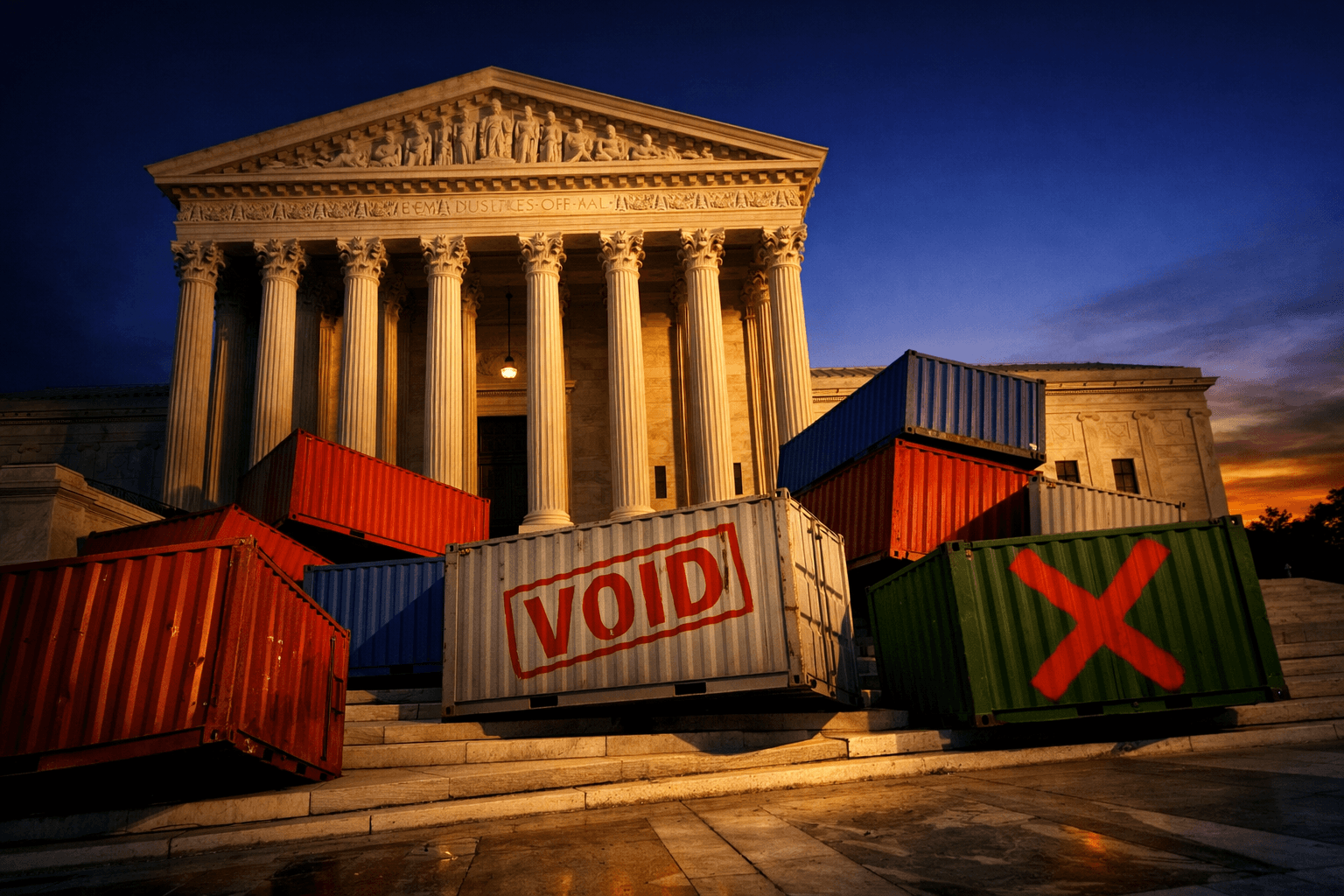
On February 20, 2026, the United States Supreme Court delivered its most consequential trade policy ruling in decades. In Learning Resources, Inc. v. Trump (consolidated with Trump v. V.O.S. Selections), the Court held that President Trump's use of the International Emergency Economic Powers Act to impose tariffs was unconstitutional.
Chief Justice John Roberts, writing for the majority and joined by Justices Sotomayor, Kagan, Gorsuch, Barrett, and Jackson, found that IEEPA does not authorize the President to impose tariffs. Justices Thomas, Alito, and Kavanaugh dissented.
Key Quote from the Majority Opinion
"Based on two words separated by 16 others in IEEPA - 'regulate' and 'importation' - the President asserts the independent power to impose tariffs on imports from any country, of any product, at any rate, for any amount of time. Those words cannot bear such weight." - Chief Justice Roberts
The ruling effectively eliminates approximately half of all tariffs currently in force. According to the Yale Budget Lab, the average effective U.S. tariff rate fell from roughly 16.9% to 9.1%- still the highest since 1946 (excluding 2025), but a significant reduction from the levels that had pushed rates to their highest since the Smoot-Hawley era.
What Was Struck Down
Every tariff imposed under IEEPA authority has been invalidated. This includes three major categories of trade actions taken since January 2025.
Reciprocal "Liberation Day" Tariffs
On April 2, 2025, President Trump imposed reciprocal tariffs on nearly every U.S. trading partner, with rates ranging from 10% to over 50%. These represented the largest single tariff action in modern history. Countries like Vietnam (46%), Taiwan (32%), India (26%), Thailand (36%), and the European Union (20%) saw steep additional duties on all exports to the United States. All of these are now void.
Fentanyl-Related Tariffs on China, Mexico, and Canada
Beginning in February 2025, the administration imposed tariffs on the three largest U.S. trading partners, citing the fentanyl emergency. China faced an additional 20% IEEPA tariff (on top of existing Section 301 duties), while Mexico and Canada faced 25% tariffs (with USMCA-compliant goods later exempted). These fentanyl-specific IEEPA tariffs are now eliminated.
Country-Specific IEEPA Tariffs
Individual IEEPA tariffs were also imposed on countries including Brazil (10%) and India (26%), as well as higher rates negotiated down through bilateral deals. All tariffs deriving their authority from IEEPA presidential proclamations and executive orders have been struck down.
Important Nuance
IEEPA tariffs were structured to exclude goods already subject to Section 232 duties, and USMCA-compliant goods from Canada and Mexico were already exempt from most IEEPA tariffs. This means the practical impact varies significantly by product and country of origin.
What Remains in Effect
The ruling does not eliminate all tariffs. Duties imposed under other legal authorities were not challenged in this case and remain fully in force.
Tariff Authority Scope Rates Status Section 301 Chinese goods (Lists 1-4A) 7.5% – 25%
Active Section 232 – Steel Steel imports (most countries) 25%
Active Section 232 – Aluminum Aluminum imports (most countries) 25%
Active Section 232 – Autos Automobiles and auto parts 25%
Active Section 232 – Copper Copper products 25%
Active Section 232 – Lumber Timber and wood products Varies
Active IEEPA – Reciprocal 10-50% on most countries
10% – 50% Struck Down IEEPA – Fentanyl (CN) China additional tariff
20% Struck Down IEEPA – Fentanyl (MX/CA) Mexico and Canada 25% Struck Down
How This Affects Duty Calculations by Country
The impact varies dramatically depending on the country of origin and product type. Here's how the landscape has shifted for the most common sourcing countries.
China
Chinese goods were subject to stacked tariffs: base duty + Section 301 (7.5-25%) + IEEPA fentanyl (20%) + IEEPA reciprocal. With IEEPA removed, importers still face significant Section 301 tariffs, but the total rate drops substantially. For example, a Section 301 List 3 product at 25% previously faced an additional 20%+ in IEEPA duties. That IEEPA layer is now gone. Section 232 tariffs on Chinese steel (25%) and aluminum (25%) remain.
Mexico and Canada
USMCA-compliant goods were already exempt from most IEEPA tariffs, so the practical change for compliant importers is modest. However, non-USMCA goods from Mexico and Canada that were paying 25% fentanyl tariffs now face only base duties. Section 232 tariffs on autos, steel, and aluminum from these countries remain.
Vietnam, India, Taiwan, Thailand, EU
These countries were primarily affected by reciprocal tariffs and see the most dramatic relief. Vietnam drops from a 46% IEEPA rate to base duties only (generally low or zero). India drops from 26%, Taiwan from 32%, Thailand from 36%. EU countries lose their 20% reciprocal tariff entirely.
Calculate Your New Duty Rate
Our tariff calculator has been updated to reflect today's ruling. Enter your HTS code and country of origin to see exactly how much your duties have changed.
Open Tariff CalculatorView Tariff Index by Country
The Refund Question: Up to $142 Billion at Stake
Justice Kavanaugh's dissent raised the refund issue head-on, noting that the government may be required to return billions to importers. According to U.S. Customs and Border Protection data, approximately $142 billion in IEEPA tariff revenue was collected through 2025 and early 2026. The ruling did not specify a refund mechanism, but the Court of International Trade has asserted jurisdiction over the process.
What We Know About the Refund Process
The CIT ruled in December 2025 that it has the authority to order reliquidation and refunds, and that importers have a two-year statute of limitations to file claims. More than 2,000 protective lawsuits have already been filed at the CIT, including by major importers. CBP transitioned to electronic refunds via ACH as of February 6, 2026, which should streamline any mass refund process.
What Importers Should Do Now
1. Audit your entries. Identify all imports that were subject to IEEPA tariffs (Chapter 99 headings 9903.01.xx). Separate IEEPA duties from Section 301, Section 232, and base duties in your records.
2. Monitor liquidation status. Check the liquidation status of your entries in ACE. Unliquidated entries may be reliquidated at the correct (lower) rate automatically.
3. Prepare to file protests. For liquidated entries, you may need to file CBP Form 19 protests within 180 days of liquidation. Consult a licensed customs broker or trade attorney.
4. Consider protective CIT filing. If your IEEPA duty exposure is significant (six figures or more), consider filing a protective action at the Court of International Trade to secure your place in the refund queue.
What Happens Next: Can Tariffs Be Reimposed?
The Trump administration has signaled it will pursue alternative tariff authorities to rebuild its trade barriers. However, each alternative comes with significant limitations compared to the sweeping power IEEPA provided.
Authority Max RateTime Limit Requirements
Section 122 15% 150 days Must address trade deficits; Congress can extend
Section 301 No cap 4-year review USTR investigation required; targets unfair practices
Section 232 No cap On-going Commerce Dept. investigation; national security basis
Section 338 50% On-going Counter-discrimination; rarely used
Several Section 232 investigations are already underway for semiconductors, pharmaceuticals, critical minerals, aircraft, and other sectors. These could result in new tariffs, but the investigation process takes months and the scope is necessarily narrower than what IEEPA allowed. The administration cannot simply replicate the universal tariff regime it built under IEEPA using these tools.
Timeline of the IEEPA Tariff Legal Battle:
Feb 2025
First IEEPA tariffs take effect: fentanyl-based duties on China, Mexico, and Canada.
April 2, 2025
"Liberation Day" — reciprocal tariffs imposed on nearly every U.S. trading partner under IEEPA authority.
April 14, 2025
V.O.S. Selections and four other small businesses file suit in the Court of International Trade.
May 2025
CIT rules IEEPA tariffs unlawful in V.O.S. case; injunction stayed pending appeal.
Aug 29, 2025
Federal Circuit affirms 7-4: IEEPA does not authorize tariffs. Tariffs stay in effect during Supreme Court review.
Sept 9, 2025
Supreme Court agrees to expedited review; consolidates Learning Resources and V.O.S. cases.
Nov 5, 2025
Oral arguments held. Justices from both ideological wings express skepticism toward government's position.
Dec 15, 2025
CIT rules it has authority to order refunds; first IEEPA entries begin liquidating (314 days from Feb 2025).
Feb 20, 2026
Supreme Court rules 6-3: IEEPA tariffs are unconstitutional.
Economic Impact: What the Data Shows
The Yale Budget Lab, which has tracked tariff impacts throughout 2025 and 2026, published updated analysis within hours of the ruling. Their findings indicate that the post-SCOTUS tariff landscape still imposes costs on the U.S. economy, but at roughly half the level of the full IEEPA regime.
Yale Budget Lab Key Findings (Feb 20, 2026)
Effective tariff rate: Drops from 16.9% to 9.1% (pre-substitution), a 6.7 percentage point reduction. Still highest since 1946 excluding 2025.
Consumer impact: Average household burden falls from approximately $1,300-$1,700 to $600-$800 in 2026.
Revenue impact: Post-SCOTUS tariffs raise $1.2 trillion over ten years (vs. $2.7 trillion with IEEPA). Refunds create a temporary positive fiscal impulse.
GDP impact: Long-run GDP reduction shrinks from -0.3% to -0.1% (roughly $30 billion annually vs. $100 billion).
Employment: Unemployment impact falls from 0.6pp to 0.3pp by end of 2026.
U.S. stock markets rose following the announcement, reflecting investor relief at the reduction in trade barriers. The sectors hardest hit by tariffs — retail, consumer electronics, and manufacturing companies dependent on imported components — saw the sharpest gains.
What This Means for Importers and Supply Chains
For businesses that have been navigating the most volatile tariff environment in a century, the ruling brings both clarity and continued uncertainty. The immediate effect is lower landed costs on goods from most countries. But the administration's stated intent to reimpose tariffs through other channels means businesses cannot yet fully restructure their supply chains.
Importers who shifted sourcing away from tariffed countries may now reconsider those moves, but should do so cautiously given the potential for new Section 232 or Section 301 actions. The smart approach is to maintain supply chain flexibility while taking advantage of the current lower-rate environment.
For companies with significant past IEEPA duty payments, the refund process represents a meaningful cash flow opportunity. However, the mechanics and timeline remain uncertain. Proactive record-keeping and consultation with trade counsel are the best ways to position for maximum recovery.
Stay Ahead of Tariff Changes
Gateway's tariff intelligence is updated within hours of policy changes. Get alerts when rates change for your products and sourcing countries.
Calculate Duties NowGet Free Tariff Alerts
Sources & References
Supreme Court of the United States — Learning Resources, Inc. v. Trump / Trump v. V.O.S. Selections, decided Feb. 20, 2026
SCOTUSblog — Supreme Court strikes down tariffs (Feb. 20, 2026)
Yale Budget Lab — State of U.S. Tariffs: February 20, 2026
NPR — 7 key things to know about Trump's tariffs after the Supreme Court decision
NBC News — Supreme Court strikes down most of Trump's tariffs
Thompson Hine SmarTrade — U.S. Supreme Court Invalidates IEEPA
Tax Policy Center — Supreme Court Ruling on IEEPA Tariffs Could Ease Cost Burdens
CNBC — What a Supreme Court tariff ruling may mean for your money
Congressional Research Service — Presidential 2025 Tariff Actions: Timeline and Status
U.S. Customs and Border Protection — IEEPA Frequently Asked Questions
Disclaimer: This article is for informational purposes only and does not constitute legal or financial advice. Gateway Lines is not a law firm or licensed customs broker. Consult qualified professionals for advice specific to your situation. Tariff rates and regulations are subject to change.
© 2026 Gateway Lines. All rights reserved. | gatewaylines.com | tariff.gatewaylines.com