Category: News Date: Aug 4, 2026 Meta description: DHS added 43 companies to the UFLPA Entity List effective August 3, 2026, the largest expansion ever. Who was added and what importers should check now. Slug: uflpa-entity-list-expansion-august-2026 Dek: DHS added 43 companies to the UFLPA Entity List effective August 3, and one traceable input from any of the 187 listed entities can detain your entire shipment.
Excerpt: The largest expansion in the history of the UFLPA Entity List took effect August 3, adding 43 companies and bringing the total to 187. Nearly half the new names sit outside Xinjiang, in provinces like Shandong, Jiangsu, and Henan, which is exactly where geography-based supplier screening goes blind. There is no de minimis threshold, so a single input traceable to a listed entity can detain the whole container. Here is who was added, how the presumption works, and what to check before your next booking.
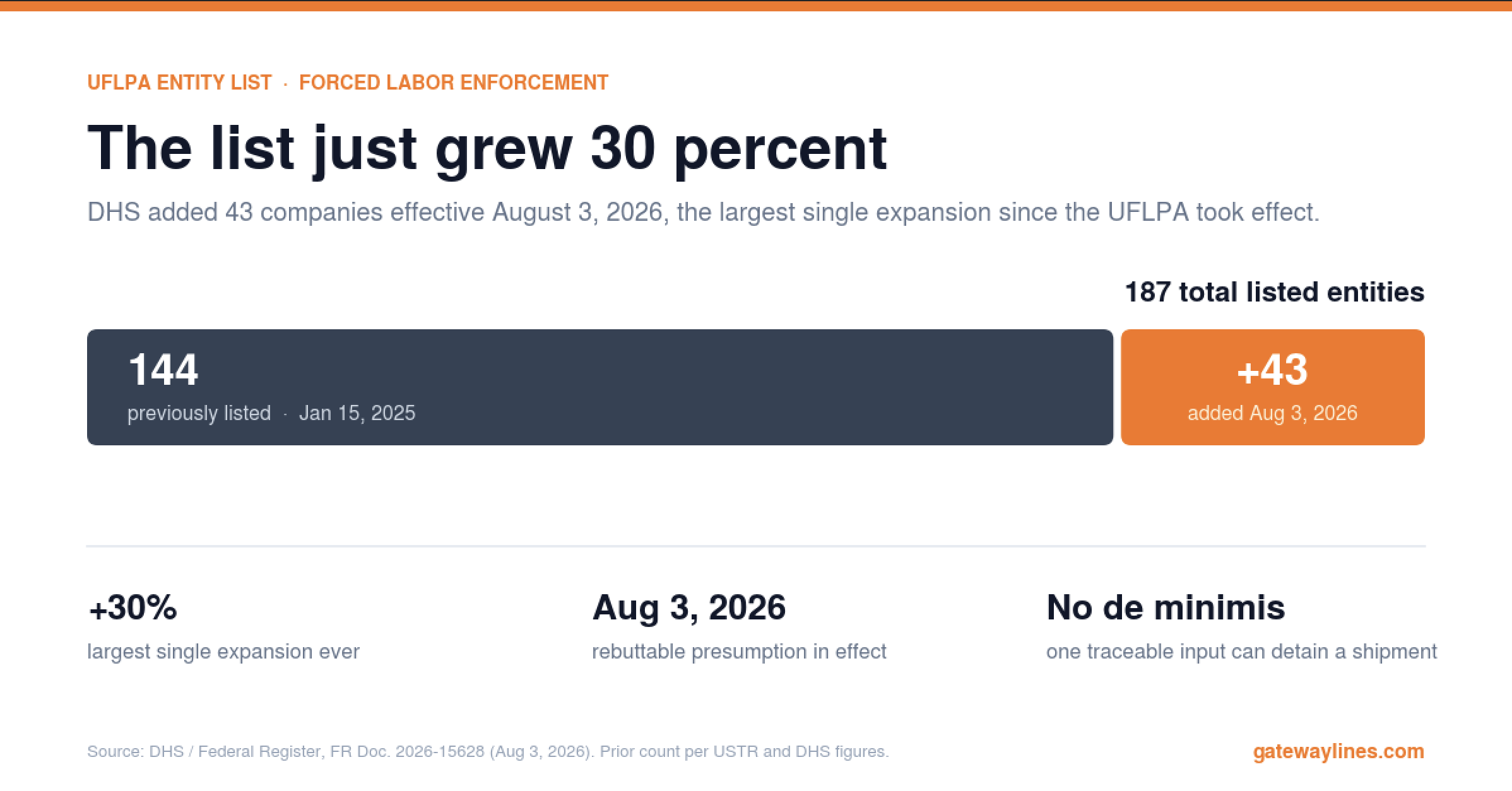
On July 31, 2026, the Department of Homeland Security, on behalf of the Forced Labor Enforcement Task Force, announced the addition of 43 companies to the Uyghur Forced Labor Prevention Act Entity List, along with technical name updates to two entities already listed. The updated list published in the Federal Register on August 3 (FR Doc. 2026-15628) and took effect the same day.
The numbers make this the single largest expansion since the UFLPA was enacted in December 2021. The list grows from 144 entities to 187, a 30 percent increase, and it is the first expansion since January 15, 2025.
This is not a tariff. It is worse than a tariff for the cargo it touches. A duty raises your landed cost. The Entity List stops your container at the port.
How the Entity List actually works
The UFLPA establishes a rebuttable presumption that goods mined, produced, or manufactured wholly or in part in the Xinjiang Uyghur Autonomous Region, or by any entity on the UFLPA Entity List, are made with forced labor and therefore prohibited from entry into the United States under 19 U.S.C. 1307. CBP enforces the presumption at the border.
Three features of that sentence do the damage.
"Wholly or in part" means there is no de minimis threshold. Any amount of input traceable to a listed entity can warrant detention of the entire shipment. A listed company does not have to make your product. It only has to make something inside your product.
The presumption attaches to the entity, not the region. Goods from a listed company are presumed prohibited even if the company sits nowhere near Xinjiang and even if the specific shipment contains no Xinjiang-origin material. That is the entire point of this expansion, as covered below.
Rebutting it is a documentation exercise most importers cannot pass on short notice. To get detained goods released, an importer must present clear and convincing evidence that the goods were not produced with forced labor, supported by complete upstream supply chain documentation. Clear and convincing is a demanding legal standard, and "complete upstream" means mapping tiers of suppliers most companies have never asked about.
Nothing in the notice grandfathers goods already in transit. The presumption is an admissibility rule that applies when cargo is presented for entry, so a container that sailed before the announcement still arrives into the new list.
Who was added
DHS identified the additions as companies in high-priority enforcement sectors: aluminum, apparel, copper, cotton, and tomatoes and downstream products.
The downstream reach is wider than those five words suggest. The new entities include producers connected to EV battery aluminum foil, gold mining and smelting, lithium and potash, food products, and pharmaceuticals. The pharmaceutical reach is unusually specific: the notice lists a pharmaceutical corporate family, including Xinjiang Nuziline and its parent Tefeng, in connection with sourcing pregnant mare urine from Xinjiang for conjugated estrogen production. Named additions include Shandong Gold Mining, the Xinren Aluminum group, TBEA, Henan Tongzhou Cotton Industry, Nanjing Lilai Pharmaceutical Technology, and Fujian Septwolves Industry, a menswear brand.
The additions came through two legal pathways. Four entities were listed for participating in Xinjiang government labor transfer programs. Forty-one were listed for sourcing material from Xinjiang or cooperating with the regional government or the Xinjiang Production and Construction Corps on so-called poverty alleviation or pairing assistance labor programs. Two entities appear under both.
The part that breaks supplier screening
Nearly half of the 43 newly listed companies are located outside Xinjiang, across at least seven provinces including Shandong, Jiangsu, Henan, Fujian, Anhui, Hunan, and Shaanxi.
Read that against how most importers actually screen. The common control is geographic: flag suppliers in Xinjiang, treat everything else in China as ordinary risk. That control now misses nearly half of the new additions. Shipments from these companies can be detained even when the shipment itself contains no Xinjiang-origin input, because the presumption follows the entity.
The fix is not a better map. It is entity-level screening of suppliers and their inputs against the current list, refreshed every time the list changes. The consolidated list is published at dhs.gov/uflpa-entity-list, and the August 3 Federal Register notice supersedes every prior version.
One more distinction worth being precise about, because two different forced labor actions landed within ten days of each other this summer. The Section 301 forced labor duties that took effect July 24 are a tariff: covered goods enter, and you pay more. The UFLPA Entity List is an admissibility bar: covered goods do not enter at all, and no payment makes them legal. An importer can owe the first and be stopped by the second on the same container.
Section 301 forced labor duties | UFLPA Entity List | |
|---|---|---|
What it is | An additional tariff | An admissibility bar |
Legal authority | Section 301, Trade Act of 1974 | UFLPA and 19 U.S.C. 1307 |
In effect | July 24, 2026 | Statute since June 21, 2022; this expansion August 3, 2026 |
Covers | Goods from 60 economies | Goods made wholly or in part by 187 listed entities |
At the border | Goods enter and additional duty applies | Goods presumed prohibited and detained |
The way out | Pay the duty; apply exemptions where available | Clear and convincing evidence plus full upstream documentation |
Does paying fix it | Yes, it is a cost | No payment makes barred goods legal |
Enforcement is not theoretical
Since the UFLPA took effect, CBP has denied entry to more than 24,300 shipments valued at nearly $1 billion, per DHS's own announcement of this expansion.
Detention math is unforgiving. Storage and demurrage accrue while the case is examined, the burden of proof sits entirely on the importer, and the documentation that wins a release has to exist before the container ships, not after it is held.
What to check this week
Pull the updated list from dhs.gov/uflpa-entity-list and screen every China-linked supplier against it, including alternate and former company names, which the list includes.
Go one tier down. If you import aluminum products, apparel, cotton goods, copper, food products, or pharmaceuticals, ask your suppliers who makes their inputs, and screen those names too. The presumption reaches inputs, not just finished goods.
Get upstream documentation in hand now. Purchase orders, production records, and raw material sourcing maps assembled before shipment are the difference between a releasable detention and an abandoned container.
Decide your detention response in advance. The two paths are proving the goods are outside the scope of the presumption, or rebutting the presumption with clear and convincing evidence. Both are document fights, and both run faster when the file already exists.
If a supplier cannot tell you where its inputs come from, treat that as the answer.
Gateway Lines is an FMC-licensed NVOCC and ocean freight forwarder handling FCL and LCL shipments across all commodity types, and tracks forced labor enforcement alongside tariff policy because both decide whether a container clears. For landed cost modeling on any lane, the free U.S. Import Tariff Simulator is at tariff.gatewaylines.com.
Sources
DHS press release, July 31, 2026: dhs.gov/news/2026/07/31/dhs-announces-addition-43-companies-uflpa-entity-list
Federal Register, Notice Regarding the Uyghur Forced Labor Prevention Act Entity List, August 3, 2026, FR Doc. 2026-15628
UFLPA Entity List (current consolidated version): dhs.gov/uflpa-entity-list