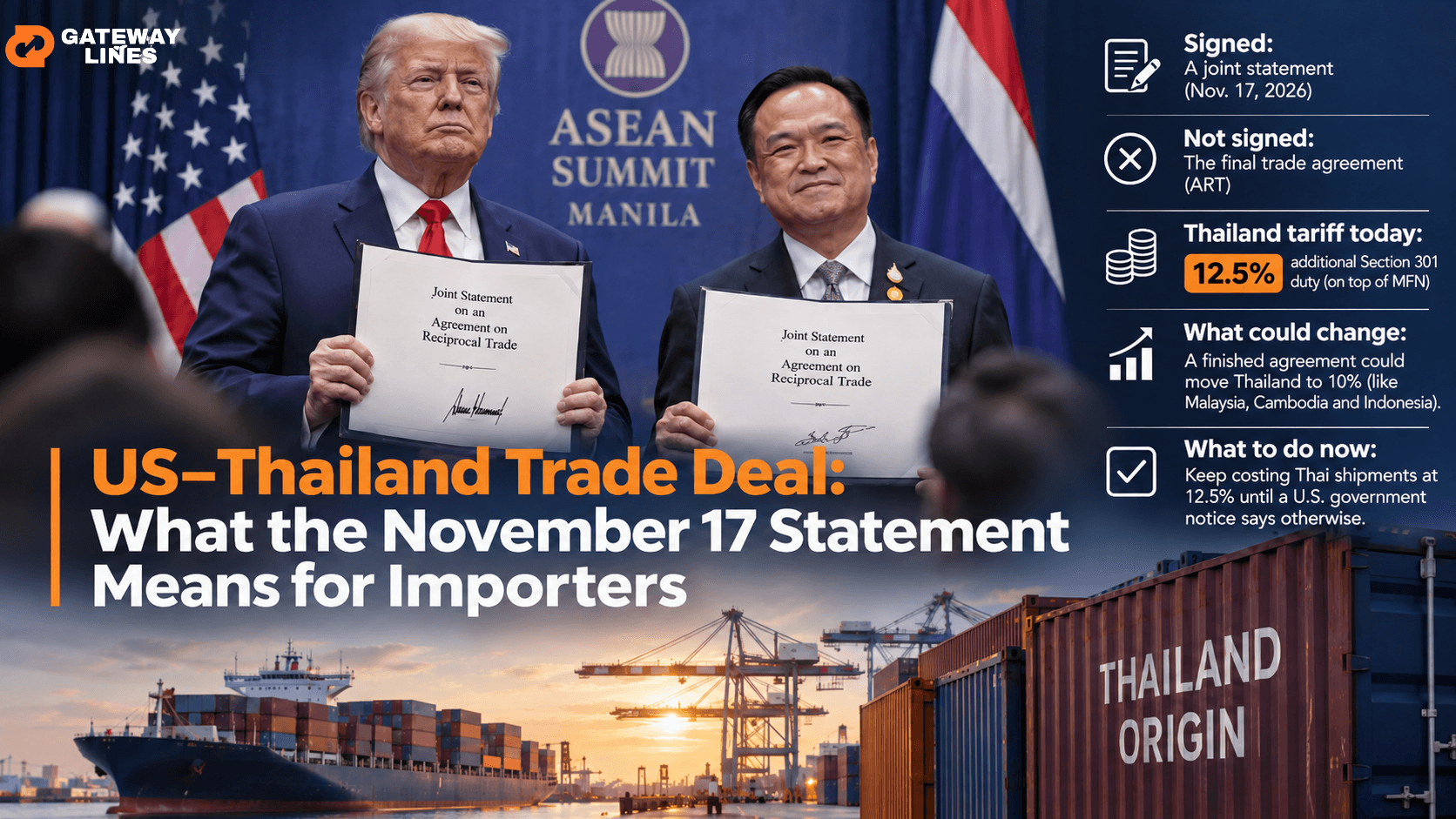
Nov 17, 2026 · Gateway Lines The US-Thailand trade deal moved a step closer on November 17, 2026, but the tariff on imports from Thailand has not changed. Products of Thailand still pay an additional 12.5% Section 301 duty on top of the normal duty rate, the same as the day before the signing.
President Trump and Thai Prime Minister Anutin Charnvirakul signed a joint statement in Manila saying the two countries have reached "substantial conclusion" on an Agreement on Reciprocal Trade. The statement is not the agreement itself. It names no tariff rate and no effective date.
Key facts for importers
Signed: a joint statement, November 17, 2026, in Manila, on the sidelines of the ASEAN Summit.
Not signed: the final Agreement on Reciprocal Trade (ART). Both governments still have to finish their internal processes.
Thailand tariff rate today: 12.5% additional Section 301 duty on most products, in effect since July 24, 2026.
What could change: Malaysia, Cambodia and Indonesia pay 10% instead of 12.5%. A finished agreement is Thailand's route to the same tier.
What to do now: keep costing Thai shipments at 12.5% until a US government notice says otherwise.
What did the US and Thailand sign on November 17?
They signed a short joint statement, not a trade agreement. The White House text says three things:
Negotiations for an Agreement on Reciprocal Trade have reached "substantial conclusion."
The agreement builds on the 1966 Treaty of Amity and Economic Relations and the 2002 Trade and Investment Framework Agreement.
Both countries will now begin their internal processes to prepare the agreement for signature and entry into force.
The statement itself lists no tariff rate, no product list, no purchase amounts and no dates.
The details came from President Trump's remarks at the signing, not from the document. He said Thailand will eliminate all tariffs on US exports, remove non-tariff barriers on American vehicles, medical devices, pharmaceuticals, ethanol and poultry, and buy $2.6 billion in additional US agricultural products. He said the formal agreement would be finalized "in the coming weeks."
Thailand's government was more cautious. A Thai deputy spokeswoman told AFP the signing "is not yet the formal ART agreement" and that Thailand still needs a public consultation and legal procedures. Nobody has given a date.
Note what is missing from all of it: any statement about what the US will charge on Thai goods.
What is the US tariff on imports from Thailand right now?
Products of Thailand pay an additional 12.5% duty under Section 301, added on top of the regular (MFN) duty rate for the product. That rate took effect at 12:01 a.m. Eastern on July 24, 2026, when the US Trade Representative acted against 60 economies over forced labor import rules. The USTR notice of action sets 12.5% for Thailand by name.
The November 17 statement does not touch that duty. An entry of Thai goods filed this week is assessed exactly as it was last week.
Two things lower or remove the 12.5% on a given shipment:
Section 232 goods. Products already paying Section 232 duties, such as steel, aluminum, copper, autos and auto parts, are not charged the forced labor duty as well.
Annex exemptions. The USTR notice lists exempt tariff lines. Check your HTS code before assuming the full 12.5%.
How Thailand compares with its neighbors
Origin | Additional Section 301 forced labor duty | Why |
|---|---|---|
Thailand | 12.5% | No finished trade agreement yet |
Vietnam | 12.5% | Same tier as Thailand |
Philippines | 12.5% | Same tier as Thailand |
Malaysia | 10% | Lower tier |
Cambodia | 10% | Lower tier |
Indonesia | 10% | Lower tier |
Rates are from the USTR notice of action and apply on top of the MFN rate. See our Section 301 forced labor tariffs guide for all 60 economies.
Will the Thailand tariff rate drop to 10%?
It can, but not yet, and not automatically. The USTR notice gives the 10% rate to economies that either impose a forced labor import prohibition or have "committed to impose and enforce such a prohibition through an Agreement on Reciprocal Trade." That is how Malaysia, Cambodia and Indonesia landed at 10%.
Thailand is not there because its agreement is not finished. For the rate to move, two things have to happen:
The final agreement is signed and includes that forced labor commitment, or Thailand adopts its own import ban.
USTR publishes a change to the Section 301 action. Until a notice appears, CBP keeps collecting 12.5%.
On a shipment with a $100,000 entered value, the difference is $2,500: $12,500 in additional duty at 12.5% versus $10,000 at 10%.
What should importers of Thai goods do now?
Plan on 12.5% and treat anything lower as upside.
Cost at the current rate. Quote, budget and price purchase orders at MFN plus 12.5% until a US government notice changes it.
Do not hold cargo waiting for a cut. There is no date for the final agreement, and storage and stockouts cost more than a possible 2.5 points.
Confirm country of origin. A lower Thailand rate would raise the stakes on transshipment checks. Goods finished in Thailand from Chinese inputs need origin documents that hold up.
Check your HTS code. Section 232 goods and annex-exempt lines do not pay the 12.5% at all.
Run the landed cost both ways. Use the Gateway Lines tariff calculator to compare 12.5% and 10% on your own product before your next order.
What to watch next
Three events would actually change what you pay, in this order:
The signed agreement text. This is the first document that should say what the US gives Thailand, including any tariff treatment.
Thailand's domestic steps. The public consultation and legal procedures have to finish before the agreement can enter into force.
A USTR or Federal Register notice. Only this changes the rate CBP collects. A CBP CSMS message with filing instructions normally follows.
Until the third one is published, the rate is 12.5%.
FAQ: US-Thailand trade deal and tariffs
Is the US-Thailand trade deal final? No. The November 17, 2026 document is a joint statement that negotiations are substantially concluded. The Agreement on Reciprocal Trade still has to be signed and brought into force.
What is the tariff on imports from Thailand in 2026? Most products of Thailand pay their regular MFN duty plus an additional 12.5% Section 301 duty, in effect since July 24, 2026.
Did the tariff on Thai goods go down on November 17? No. The joint statement names no tariff rate and no effective date.
When will the Thailand tariff rate change? No date has been announced. President Trump said the formal agreement would be finalized in the coming weeks. Thailand says it still needs a public consultation and legal procedures.
Does the 12.5% apply on top of Section 232 tariffs? No. Products subject to Section 232 duties are exempt from the Section 301 forced labor duty.
Does this change anything for cargo already on the water? No. Entries are assessed at the rate in force when the goods are entered, and that rate has not changed.
Sources
The White House, Joint Statement on an Agreement Between the United States of America and the Kingdom of Thailand on Reciprocal Trade, November 17, 2026.
Office of the US Trade Representative, Notice of Actions in Section 301 Investigations (forced labor import prohibition), published at 91 FR 47318, July 28, 2026.
US Customs and Border Protection, CSMS #69326983, Guidance: Section 301 Forced Labor Import Duties, July 23, 2026.
AFP via Yahoo Finance, Trump, Thai PM to make joint trade statement in Manila, November 17, 2026.
Just the News, Trump signs joint statement with Thailand, November 17, 2026 (President Trump's remarks at the signing).
Gateway Lines, Tariff Radar, and Section 301 Forced Labor Tariffs: 2026 Rates, Countries and Exemptions.