SURFACES AND STONE
The duty on a quartz slab can turn on when the container clears, not only where it was made
Engineered quartz moves under a safeguard tariff-rate quota, so two identical containers from the same supplier can be dutied differently depending on how much of the quota has already been consumed when each one is entered. Add antidumping that attaches to the exporter rather than the country, and a slab that weighs the box out well before it fills it, and the ocean freight is rarely the expensive line.
Written for slab importers and distributors, fabrication shops buying direct, and the kitchen, bath and builder-supply buyers who carry the duty risk on a container somebody else classified.
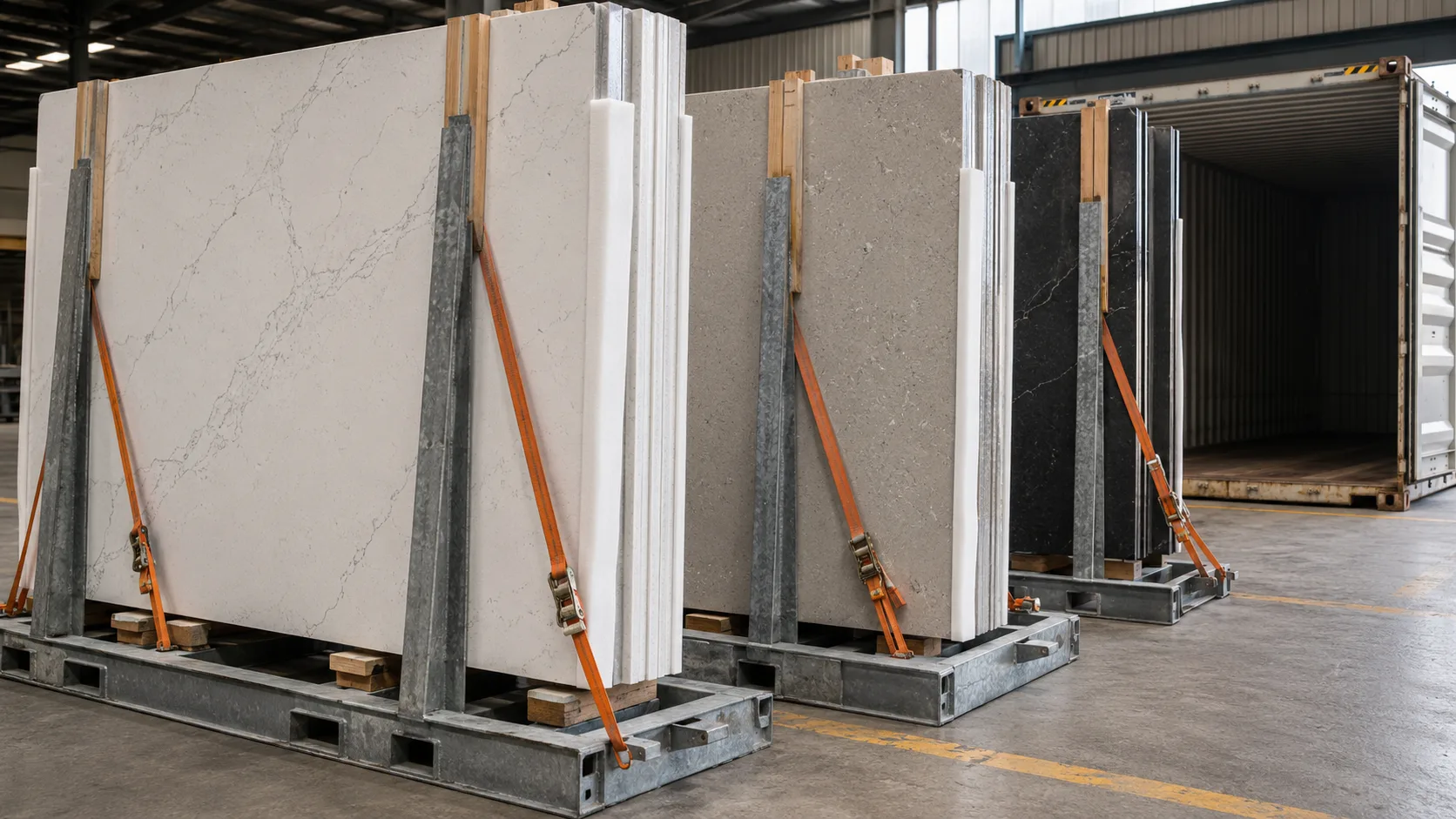
What actually crosses the border
One shipment, 5 classification lines
Duty is assessed per article, not per shipment. Each line below is a live lookup against the same tariff engine that prices Gateway bookings, so the number you see is the number in force today rather than one printed on a page months ago.
| HTS | Part | Programs that can stack | Live rate |
|---|---|---|---|
| 6810.99.00 | Engineered quartz and agglomerated stone slabsThe main line for engineered quartz. Agglomerated stone is an article of artificial stone, so it does not follow the natural stone headings even when the finished slab is indistinguishable from granite on a showroom floor. | Column 1 MFNSafeguard tariff-rate quotaSection 301 forced laborAntidumping / countervailing | Look up |
| 7020.00.60 | Glass-based surface products sold into the same categoryThe safeguard reaches glass-based surfaces too, and this line carries an ordinary duty of its own rather than entering free, so the safeguard stacks on a different base. A product merchandised beside quartz can land on entirely different arithmetic. | Column 1 MFNSafeguard tariff-rate quotaSection 301 forced labor | Look up |
| 6802.93 | Worked granite slabs, where natural stone ships alongsideNatural stone is on a different policy track from engineered. A programme can be clean on granite and exposed on quartz, or the reverse. | Column 1 MFNSection 301 forced laborAntidumping / countervailing | Look up |
| 6802.99 | Other worked monumental or building stone | Column 1 MFNSection 301 forced labor | Look up |
| 4415.20 | The wooden A-frames, bundles and pallets the slabs travel onPacking is not an afterthought on this commodity. Wood packaging material entering the United States has to meet ISPM 15 heat treatment and marking, and a non-compliant A-frame holds the whole container, not just the frame. | Column 1 MFN | Look up |
Where it goes wrong
Problems specific to this commodity
The box weighs out with room left over
A single 3200 by 1600 slab at 20 mm thickness runs around 245 kg, so a load reaches the container payload ceiling long before it fills the volume. This is also why slabs so often move in 20ft equipment rather than 40ft: of the four standard boxes the 20ft carries the highest payload, so the densest cargo buys the smallest container on purpose. A plan built from cubic metres will book equipment that cannot legally load.
Engineered, natural and glass-based slabs are three different imports
They look alike on arrival and they are frequently on the same packing list, but they classify under different headings and pick up different programmes. Quoting one blended rate across a mixed container is how a landed cost model ends up wrong by more than the freight, and the error is always discovered after the goods have shipped.
Antidumping attaches to the exporter, not the address on the invoice
Two suppliers in the same country, shipping the same slab, can carry duty rates that differ by orders of magnitude, because antidumping and countervailing rates attach to the producer and exporter combination rather than the origin. This is the exposure most often missed at purchase order stage, and it is only knowable before you buy.
A quota is a clock, and it is not running on your calendar
Under a tariff-rate quota the rate depends on whether the quota is still open when the entry is filed. The same purchase order, split across two sailings, can be dutied one way on the first container and another way on the second. That makes entry timing a commercial decision rather than a clerical one, and it is worth knowing the position before the vessel books, not after it berths.
The delivery point is a slab yard, not a loading dock
Slabs come off in A-frames and need a clamp, a boom truck or a proper slab rack at the far end. Fabrication shops and distribution yards rarely have a dock height door and a pallet jack, so the destination handling belongs in the routing decision rather than turning up as a surprise on the arrival notice.
What Gateway does about it
Priced before the PO, tracked to the site
Landed cost per HTS line, before the purchase order
Run each line on the packing list through the same tariff engine that prices our own bookings and see which programmes stack on that exact code and origin, including whether an origin is excluded from the safeguard by finding. Change the sourcing country and watch the number move before you commit to it.
Published lane rates, not a rate on request
Our ocean rates are published by lane and container size and refreshed weekly from live carrier reads. You can see the number for your lane without a sales call, and it is the same number our booking quotes use.
Weight-limited load planning
Plan the load against real payload limits rather than volume, and compare 20ft against 40ft on the cargo you actually have. For dense freight the smaller box is often the cheaper landed answer, which is the opposite of the usual instinct.
Customs and compliance across the programmes
Entry filing, ISF and classification support for containers that span engineered, natural and glass-based surfaces at once, plus the ISPM 15 questions the wood packaging on this commodity reliably attracts.
Cargo insurance and tracking for freight that breaks
Slabs chip, crack and arrive short, and a claim is only as good as the evidence behind it. Cargo cover is arranged with the booking, and satellite container tracking with last free day alerts keeps a heavy, fragile load from quietly accruing demurrage at the terminal.
Common questions
- What HTS code do engineered quartz slabs fall under?
- Engineered quartz is an agglomerated artificial stone and generally falls under heading 6810, most commonly 6810.99. Natural granite slabs classify separately under 6802.93, and glass-based surface products under 7020. Classification follows what the article IS rather than what it resembles or how it is marketed, so a quartz slab and the granite slab beside it on the same packing list do not share a code. Run the specific product and origin through the calculator rather than applying one code across the container.
- Is there a tariff on imported quartz countertops?
- Several programmes can apply at once. Engineered quartz surface products are covered by a safeguard tariff-rate quota, where the rate depends on whether the quota remains open at the time of entry; an origin-based Section 301 forced labor duty can apply on top; and antidumping and countervailing orders reach some origins and some exporters. At least one origin is excluded from the safeguard by a specific finding. Because both the rates and the quota position move, the current answer for your code and origin comes from the live calculator rather than a figure printed on a page.
- How many quartz slabs fit in a container?
- Weight decides it, not volume. At roughly 245 kg for a 3200 by 1600 slab at 20 mm, the payload ceiling arrives well before the box is full, which is why slab importers commonly buy 20ft equipment: it carries the highest payload of the standard container sizes. Plan from tonnage against a real A-frame arrangement rather than from cubic metres.
- Why did another importer pay less duty on the same slab?
- Two reasons, and both are ordinary. Antidumping and countervailing rates attach to the producer and exporter pair rather than the country, so the identical product from a different supplier in the same country can carry a very different rate. And under a tariff-rate quota, an entry filed while the quota is open is dutied differently from one filed after it fills. Same slab, same origin, different number.
- Can you deliver to a fabrication shop rather than a warehouse?
- Yes. Slab destinations are yards and fabrication shops with clamps, boom trucks and slab racks rather than dock doors and pallet jacks, so the destination handling is decided with the routing instead of being treated as a separate leg after arrival.
Price the structure before you buy it
Send the bill of materials and the origin. You get duty per line, a published lane rate, and a packing plan that respects the payload limit, before the PO is committed.