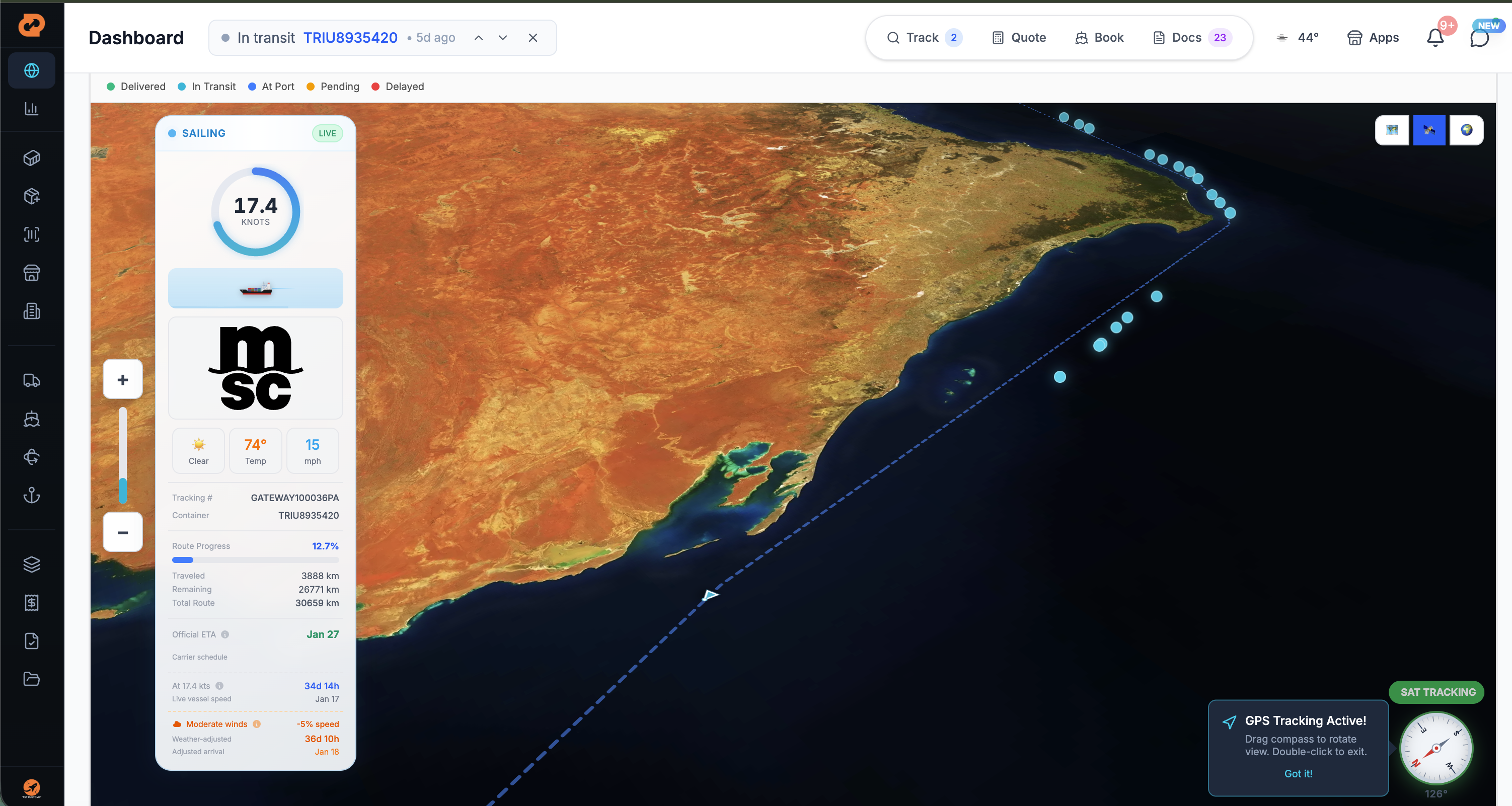
Gateway Sat Tracker represents a deliberate shift away from the limitations of traditional AIS-only tracking toward a more resilient, satellite-driven approach to global container visibility.
This is not an incremental upgrade.
It is a structural change in how shipment movement is observed, verified, and trusted.
The Limitations of Traditional AIS-Based Tracking
AIS was originally developed as a collision-avoidance and maritime safety system, not as a logistics intelligence platform. Over time, it was adapted for commercial tracking, but fundamental constraints remain.
Common limitations of AIS include:
Dependency on ship-broadcasted signals
Inconsistent coverage in remote ocean regions
Signal gaps caused by weather, congestion, or intentional shutdowns
Delayed or interpolated position data
Limited insight beyond vessel location
In practice, AIS often tells operators where a ship was, not where it is with confidence — and provides little context around shipment progress, delays, or risk.
For importers and logistics teams operating at scale, these gaps translate into uncertainty, reactive decision-making, and unnecessary cost.
Gateway’s Perspective: Visibility Requires Independence
Gateway was built on a core belief:
True visibility cannot depend solely on self-reported signals.
Modern supply chains require tracking systems that are:
Independent of a single signal source
Globally consistent
Redundant by design
Resistant to outages and blind spots
This belief led Gateway to expand beyond AIS-only tracking and invest in satellite-based observation layered with logistics intelligence.
What Gateway Sat Tracker Does Differently
Gateway Sat Tracker combines multiple data streams to deliver a more reliable and continuous view of container movement.
Rather than relying solely on ship-transmitted AIS signals, Gateway integrates:
Orbital satellite vessel positioning
Global maritime movement patterns
Carrier and port milestone data
Historical route intelligence
This layered approach reduces dependence on any single signal source and improves confidence in real-
time shipment awareness.
The result is not just “tracking,” but situational awareness.
Why Satellite-Based Tracking Outperforms AIS Alone
Satellite-driven tracking provides structural advantages that AIS alone cannot offer.
Key advantages include:
Global coverage, including open ocean and remote regions
Reduced signal loss, even in congested shipping lanes
Independent verification of vessel movement
Higher confidence ETAs derived from observed behavior, not assumptions
Continuity during AIS outages or gaps
By observing vessel movement from orbit and correlating it with logistics events, Gateway Sat Tracker provides insight that is both broader and more resilient.
From Location Data to Logistics Intelligence
Knowing where a vessel is matters — but knowing what that movement means matters more.
Gateway Sat Tracker translates raw tracking data into operational intelligence by:
Contextualizing movement against planned routes
Identifying abnormal slowdowns or deviations
Linking vessel behavior to shipment milestones
Supporting earlier detection of delays and congestion
This allows logistics teams to move from reactive tracking to proactive planning.
A Strategic Shift, Not a Marketing Claim
Gateway’s move toward satellite-driven tracking is not about abandoning AIS entirely. AIS remains a valuable signal.
The difference is philosophical and technical:
AIS becomes one input, not the foundation
Satellite observation provides independent confirmation
Visibility is built on redundancy, not assumption
This approach mirrors how critical infrastructure is designed in other industries — aviation, defense, telecommunications — where single points of failure are unacceptable.
What This Means for Importers
For Gateway customers, the impact is tangible:
Fewer blind spots during ocean transit
Earlier awareness of potential delays
Improved planning for customs, rail, and delivery
Reduced reliance on manual status updates
Greater confidence in shipment timelines
In an environment where days matter and margins are tight, this level of visibility becomes a competitive advantage.
Gateway’s Broader Vision for Visibility
Gateway Sat Tracker is part of a broader mission:
to build a logistics platform that reflects how global trade actually moves — complex, distributed, and constantly changing.
As supply chains grow more interconnected and risk-aware, visibility systems must evolve beyond tools built for a simpler era.
Satellite-based tracking is not the future because it is new.
It is the future because it is structurally better suited to the reality of global logistics.
Final Thought
The question is no longer whether shipments can be tracked.
The question is whether that tracking is complete, reliable, and actionable.
Gateway Sat Tracker was built to answer that question — from orbit to operation.