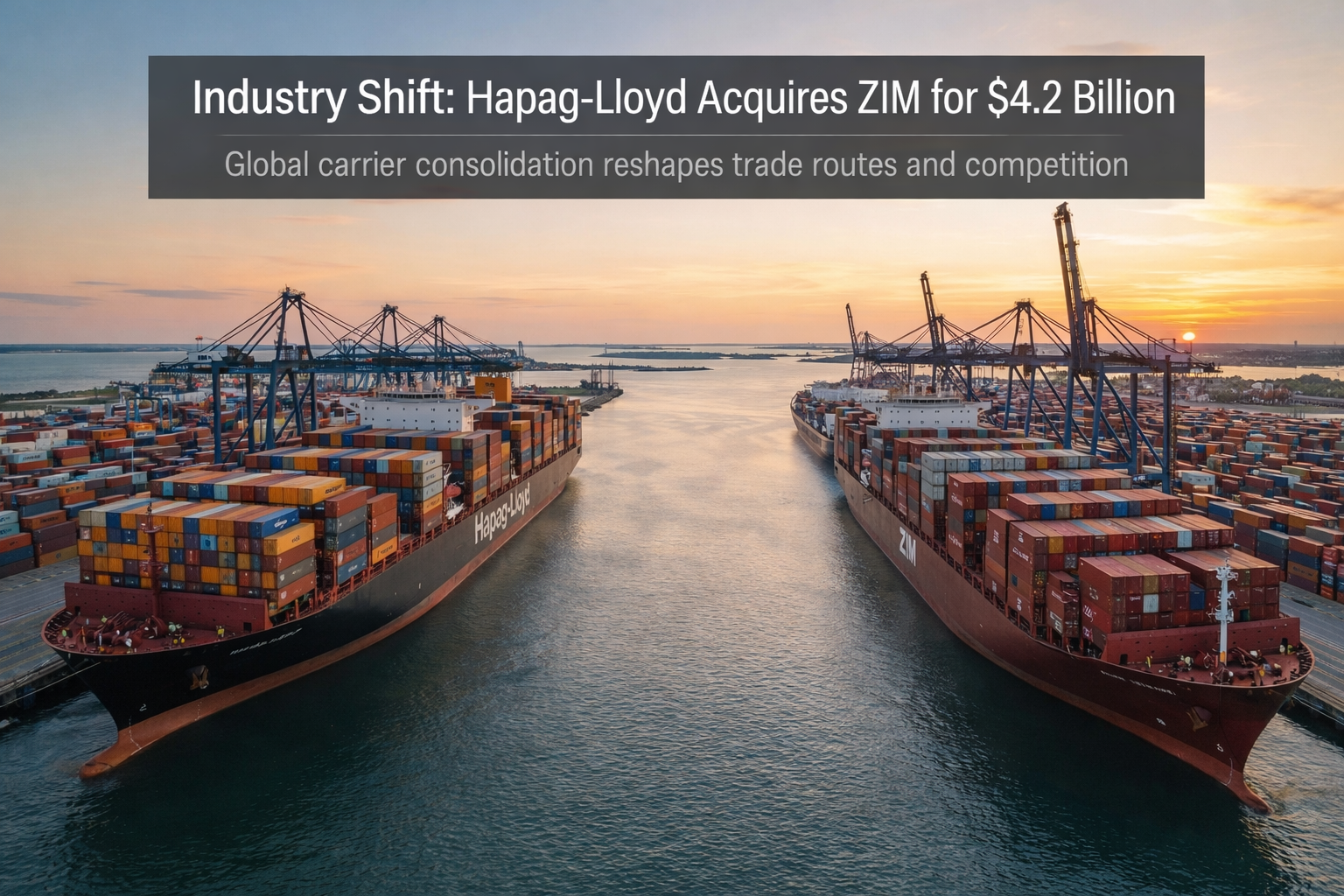
The container shipping industry just changed forever. Hapag-Lloyd announced today that it will acquire 100% of ZIM Integrated Shipping Services for $35.00 per share in cash — a deal valued at approximately $4.2 billion. The transaction represents a 58% premium over ZIM's closing stock price on February 13, 2026, and will result in ZIM's delisting from the New York Stock Exchange.
For importers, exporters, and freight forwarders, this isn't just another corporate headline. This acquisition reshapes carrier options, trade lane coverage, and pricing dynamics across some of the world's busiest shipping routes. Here's what you need to know.
The Deal Structure: Not a Simple Buyout
Unlike a straightforward acquisition, this deal has a unique split structure driven by Israeli national security requirements.
Hapag-Lloyd will acquire ZIM's international operations, including 99 chartered vessels, global trade routes outside of Israel, the international sales and marketing network, customer agreements, the ZIM brand for use outside Israel, and ZIM's technology division.
A separate Israeli entity called "New ZIM" will be formed by FIMI Opportunity Funds, Israel's largest private equity firm. New ZIM will take ownership of 16 ZIM-owned vessels, Israeli shipping routes, the Haifa headquarters, and obligations tied to Israel's "golden share" — a government mechanism that ensures the country retains strategic sealift capacity during wartime.
This structure was necessary because Hapag-Lloyd's shareholder base includes Qatar Holdings (12.3%) and Saudi Arabia's Public Investment Fund (10.2%), making full foreign ownership of a strategic Israeli asset politically and legally complex. The golden share requires that a minimum number of Israeli-flagged vessels remain available for emergency military and civilian use.
New ZIM will continue operating under the ZIM brand on Israeli trade lanes and will have access to
Hapag-Lloyd's Gemini cooperation network for broader connectivity.
What the Combined Carrier Looks Like
The numbers tell the story of a significantly more powerful carrier.
The merged entity will operate more than 400 vessels with total capacity exceeding 3 million TEU. Annual cargo volume is projected to surpass 18 million TEU by 2027. Hapag-Lloyd will move from the fifth-largest container shipping company to the fourth-largest, overtaking COSCO's container division.
The acquisition strengthens Hapag-Lloyd's presence on trade lanes where ZIM has historically been competitive, particularly Transpacific routes between Asia and the United States, Intra-Asia services, Atlantic crossings, Latin America trades, and East Mediterranean connections.
ZIM has invested heavily in fleet modernization since 2017, taking delivery of 46 newbuild containerships ranging from 5,300 TEU to 15,000 TEU. Roughly 40% of ZIM's operated capacity is now LNG dual-fuel, giving Hapag-Lloyd one of the largest LNG-capable fleets in the industry.
Why This Happened Now
ZIM's trajectory made it an attractive target. Under CEO Eli Glickman's leadership since 2017, the company went from negative equity to sustained profitability, returning approximately $5.7 billion in dividends since its 2021 IPO. Total capital returned to shareholders is expected to reach roughly $10 billion once this transaction closes.
But the shipping industry's boom-and-bust cycle caught up. After record revenue of $8.43 billion in 2024, ZIM's 2025 numbers declined sharply — EBITDA dropped 61% in Q3, revenues fell 36%, and TEU volumes decreased 5%. Houthi attacks targeting Israeli-linked shipping in the Red Sea added operational complexity and cost.
For Hapag-Lloyd, the acquisition is strategic. The German carrier turned over $22 billion in 2024 and has been looking to grow market share, particularly on Far East to U.S. East Coast routes — exactly where ZIM is strong. Hapag-Lloyd beat out Maersk, the world's second-largest carrier, in the bidding process.
What This Means for Shippers
If you currently ship with ZIM or Hapag-Lloyd, here's what to expect.
Short term (now through late 2026): Nothing changes operationally. The deal requires shareholder approval, regulatory clearances from multiple jurisdictions, and consent from the State of Israel. ZIM and Hapag-Lloyd will continue operating as separate companies with independent sales teams, pricing, and booking systems until the transaction closes — expected by late 2026.
Medium term (2027): Once the deal closes, expect a transition period. Systems will begin merging, sales teams will consolidate, and ZIM's international services will gradually rebrand under Hapag-Lloyd. Your ZIM contracts and booking relationships will migrate to Hapag-Lloyd's platform. If you've seen this before with Hamburg Süd becoming part of Maersk or APL being absorbed into CMA CGM, the playbook is similar.
Long term (2028 and beyond): ZIM as a standalone international brand will likely cease to exist outside of Israeli trade lanes. The "New ZIM" entity operated by FIMI will serve Israel-specific routes with Hapag-Lloyd network access, but for most global shippers, your carrier options just decreased by one.
The Bigger Picture: Carrier Consolidation Continues
This acquisition is the latest in a decades-long trend of ocean carrier consolidation. The pattern is unmistakable.
Maersk absorbed Hamburg Süd (2017) and Safmarine. CMA CGM acquired APL (2016) and ANL. Hapag-Lloyd itself previously merged with CSAV (2014) and UASC (2017). COSCO merged with China Shipping (2016). ONE was formed from the container divisions of NYK, MOL, and K Line (2018).
With ZIM now being absorbed, the number of truly independent major container carriers continues to shrink. The top carriers — MSC, Maersk, CMA CGM, Hapag-Lloyd (now including ZIM), COSCO, Evergreen, ONE, HMM, and Yang Ming — control an even larger share of global container capacity.
For shippers, fewer carriers means less competition on pricing and potentially less flexibility on service options. It also means the remaining carriers have more stable networks, better schedule reliability at scale, and deeper geographic coverage.
How Freight Forwarders and NVOCCs Add Value Here
Carrier consolidation is exactly why working with an experienced freight forwarder or NVOCC matters more than ever. When carriers merge, individual shippers face disrupted relationships, migrated contracts, and reduced negotiating leverage against larger entities.
A knowledgeable forwarder maintains relationships across all major carriers and alliance networks. They can pivot your cargo between carriers when service disruptions occur during integration periods, negotiate competitive rates by leveraging volume across multiple carrier options, and provide continuity when your point of contact at a carrier changes — which it will.
At Gateway Lines, we work with carriers across all major alliances and maintain the technology infrastructure to adapt quickly when the industry shifts. Whether you're currently shipping with ZIM, Hapag-Lloyd, or considering your options, our platform provides real-time tracking, competitive ocean freight rates, and the kind of hands-on service that doesn't get lost in a corporate merger.
Timeline and Next Steps
The transaction is expected to close by late 2026, subject to ZIM shareholder approval, regulatory approvals across multiple jurisdictions, consent from the State of Israel regarding the golden share transfer, and completion of the New ZIM carve-out with FIMI.
ZIM's board of directors has already approved the deal. However, Israeli government officials have signaled they may scrutinize the transaction closely, and ZIM's workers' union has launched protest actions over concerns about job security and the sale of what many consider a national strategic asset.
We'll continue monitoring this situation and providing updates as the regulatory approval process unfolds.