Between February and August 2026, the legal foundation of U.S. import tariffs was rebuilt three separate times.
On February 20, the Supreme Court held that the International Emergency Economic Powers Act did not authorize the tariffs imposed under it. The same day, Proclamation 11012 invoked Section 122 of the Trade Act of 1974 to impose a 10 percent global surcharge, effective February 24. That surcharge expired on July 24, and a new Section 301 action covering 60 economies took effect the following minute. In the same two-week window, a separate Section 301 action hit Brazil at 25 percent, three Section 338 proclamations put an additional 50 percent on a broad range of Canadian goods effective August 19, and Section 232 duties on patented pharmaceuticals went live for a first tranche of companies on July 31.
Any tariff calculator running on a rate table built in January is now wrong in at least six places.
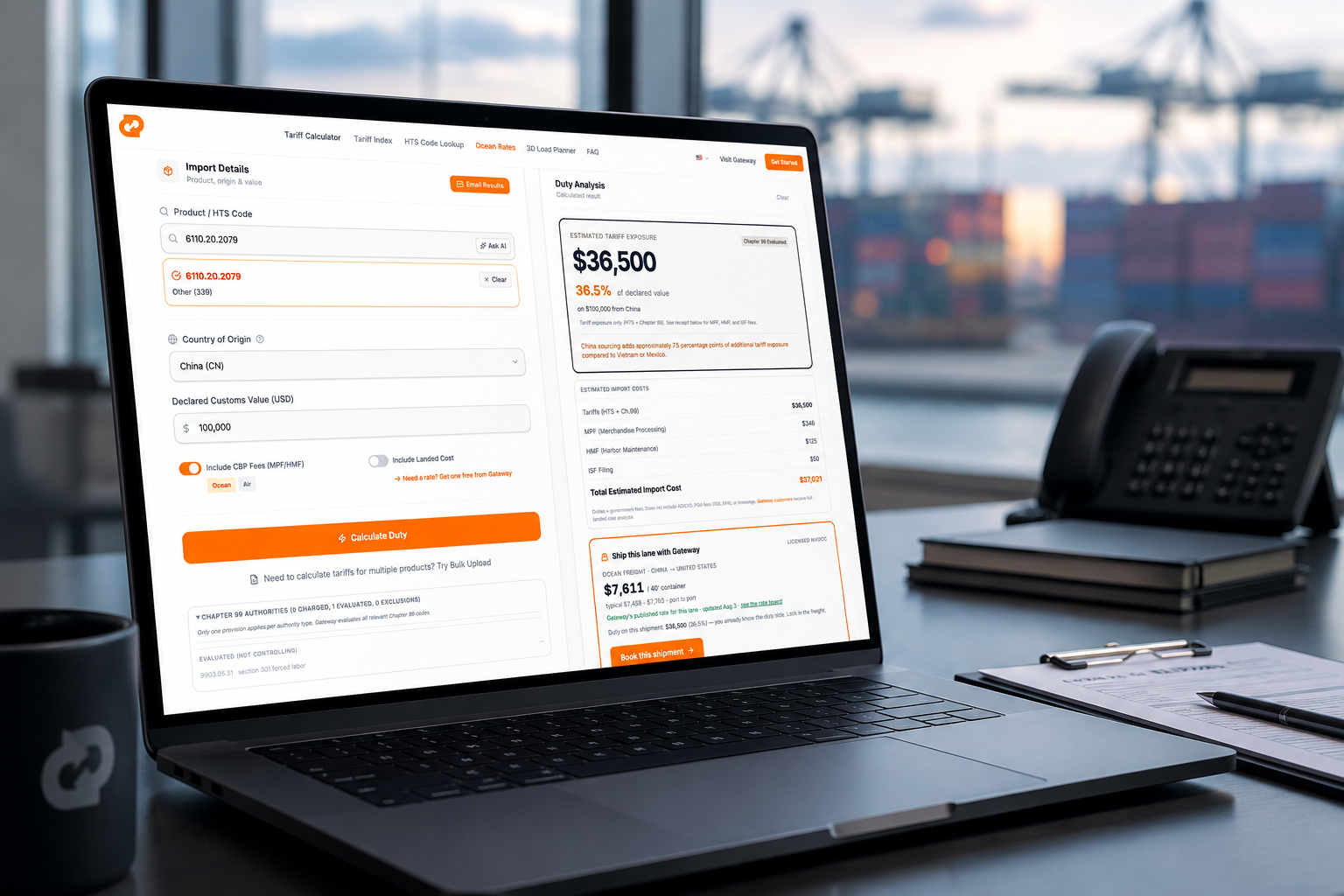
This is the story of how the Gateway Lines tariff simulator became the U.S. import tariff calculator importers come back to, and the update discipline that keeps it that way.
How It Became a Go-To Tariff Calculator
Not through advertising. Through timing and update speed.
The simulator went live into the most volatile stretch of U.S. tariff policy in decades. When the Supreme Court invalidated the IEEPA tariffs, every static rate table on the internet broke on the same day. The replacement regime had a 150-day statutory clock on it from birth. The regime after that arrived with three rate tiers, in-transit exceptions, and a stack of country and product carve-outs. Importers did not need another duty database. They needed to know what their landed cost was today, and what would change next month.
Three things made the simulator the tool people kept returning to.
It tracked the change, not just the rate. Every policy action is logged publicly with its effective date and its status, pending or implemented. A duty signed on July 20 that takes effect August 19 shows up as pending, with a plain statement that nothing is collectible before that date. Most tools show a number. Gateway's shows the number, when it starts, and what it replaced.
It answered the refund question when that became the question. The Supreme Court ruling did not just end a tariff. It opened the question of recovering duties already paid, and CBP built an entirely new refund process to handle it. Gateway's IEEPA refund calculator let importers size their exposure while most coverage was still explaining what had happened.
It stayed free and showed its work. No login. No gated PDF. A public policy changelog where every load-bearing number cites the instrument it came from.
The result is something anyone can verify: search "tariff simulator" on Google and the Gateway Lines simulator is the top 3 result. That position was not bought. It is what happens when a tool is updated the week the law changes, and the pages explaining the change cite the actual proclamations.
Why Tariff Calculators Go Stale
The failure mode is rarely a wrong rate. It is a stale one.
A tariff calculator is a snapshot of a legal regime. When the regime changes, the snapshot does not update itself. The three ways a calculator silently goes wrong:
It tracks announcements instead of instruments. A rate announced on social media, in a press conference, or in a fact sheet is not a rate anyone can be charged. Only a proclamation, a Federal Register notice, or CBP guidance creates a collectible duty, and the number in the instrument frequently differs from the number in the announcement.
It tracks the action but not the effective date. A proclamation signed on July 20 that applies to goods entered on or after August 19 creates zero liability for 30 days. A calculator that applies the duty on signature date overstates cost for a month. One that ignores in-transit exceptions overstates it for the shipments that most need an accurate number.
It tracks the headline rate but not the structure. This is the subtle one, and it is where most tools break in 2026. More on it below.
How Gateway Tracks U.S. Tariff Changes
Primary sources only, on a working-day cadence: the Federal Register, White House presidential actions, USTR investigations and final actions, USITC tariff schedule revisions, CBP's Cargo Systems Messaging Service, DHS forced labor enforcement actions, and the trade litigation dockets at the Court of International Trade and the Federal Circuit.
The last three matter more than most people expect. CBP guidance is where a proclamation becomes something a broker can actually file, down to the Chapter 99 heading. DHS entity list actions do not change a duty rate, but they can stop a container at the port. And in 2026, court orders routinely determine what is collectible and what is refundable. A monitoring stack that stops at the Federal Register misses the part of the law that moves fastest.
The Verification Standard Behind Every Rate
Every load-bearing claim behind a rate in the simulator meets one of two standards. It is verified against a primary instrument, a proclamation, a Federal Register document number, a CBP message, or a court order, with the citation recorded. Or it is presented as an inference, with the reasoning shown. The two are never mixed, and an announcement is never treated as an instrument.
Here is why that distinction earns its keep.
On February 21, 2026, the day after the Section 122 surcharge was announced at 10 percent, an intent to raise the rate to 15 percent was announced publicly. It was never formalized in a proclamation. The surcharge was imposed at 10 percent on February 24 and remained at 10 percent until it expired on July 24.
Secondary sources got this wrong for months. As of mid-2026, published tariff trackers were still describing the surcharge as having been "later raised to a reported 15 percent." An importer using a calculator built on that reading would have overstated duty on every affected entry for five months, and would have overstated any refund exposure by half.
The 15 percent figure was never a verified fact. It was an announcement. Gateway treated it as one.
How Often the Tariff Calculator Is Updated
Gateway commits to reflecting applicable policy changes in the simulator within 24 to 48 hours of publication, and maintains a public policy log at tariff.gatewaylines.com showing what changed, when, and with what effective date.
Three disciplines sit behind that log.
Pending versus implemented. An action with a future effective date is logged as pending and does not affect a landed cost estimate for a shipment entering before that date. The Section 338 Canada duties were logged on signature and flagged pending, with the note that nothing is collectible before 12:01 a.m. eastern time on August 19, 2026.
In-transit exceptions are modeled, not footnoted. The Section 301 forced labor action exempts goods loaded onto a vessel and in transit on the final mode before July 24, 2026, provided they are entered for consumption before July 28. The Brazil action carries its own in-transit provision under a separate Chapter 99 heading. For ocean freight these are not edge cases. They are the shipments in the water right now.
Reporting requirements are logged even at zero duty. From July 31 through September 28, 2026, importers of goods under the affected Chapter 29 and Chapter 30 classifications must report a Chapter 99 heading carrying no additional duty. Zero rate, mandatory filing. A calculator that only tracks money misses it. A freight forwarder cannot.
The Hardest Parts of Calculating 2026 U.S. Import Tariffs
Structured rates that vary by HTS line. The Section 301 forced labor final action is widely described as a two-tier structure, 10 percent or 12.5 percent by country of origin. It is three tiers. For the European Union, Taiwan, Japan, South Korea, and Switzerland, the additional duty is calculated net of the product's most favored nation rate, capping the total at 10 or 12.5 percent depending on origin, and falling to zero where the MFN rate already meets the cap. The correct number is not determinable from country alone. Any tool doing country-level lookup for those five origins returns the wrong answer.
Exemptions that depend on entry facts, not classification. Some carve-outs, such as civil aircraft use, donations for humanitarian relief, and informational materials, cannot be resolved from an HTS code. The simulator applies subheading-based exemptions automatically and flags fact-dependent ones for review rather than guessing.
Carve-outs that do not travel. USMCA-qualifying status exempted goods from the Section 122 surcharge. It does not exempt covered goods from the Section 338 duties taking effect August 19. Treating any preference program as a blanket exemption across regimes is the most common structural error in this category of tool.
Stacking order. Section 232 goods are excluded from several of the 2026 Section 301 and Section 338 actions. Which action applies, and which is displaced, changes the answer materially on the same commodity.
What a Tariff Calculator Cannot Do
The simulator produces a landed cost estimate. It does not produce a binding classification, and it is not a substitute for a licensed customs broker.
Classification is a legal determination. Where an HTS code is genuinely ambiguous, or where a fact-dependent exemption is in play, the answer belongs with a licensed broker, and a binding ruling from CBP is available for cases where certainty matters more than speed. Gateway works alongside a licensed customs broker of record on every entry it coordinates, and will say plainly when a question is above what any calculator should answer.
The goal is to be the tool that says "check this one," not the tool that is confidently wrong.
Frequently Asked Questions
How quickly do new tariff actions appear in the simulator? Applicable policy changes are reflected within 24 to 48 hours of official publication. Each change is logged publicly with its effective date and its status, pending or implemented.
Is the Gateway Lines tariff simulator free? Yes. The simulator is free at tariff.gatewaylines.com, with no login and no gated content, and the full policy changelog is published alongside it.
Which 2026 tariff actions does the calculator cover? The simulator tracks the U.S. trade actions in its public policy log, including the Section 301 forced labor duties covering 60 economies, the Brazil Section 301 action, Section 232 duties, the Section 338 Canada duties taking effect August 19, and the expired Section 122 surcharge, with effective dates and in-transit exceptions modeled.
Can a tariff calculator replace a customs broker? No. A calculator produces a landed cost estimate. Classification is a legal determination, and fact-dependent exemptions belong with a licensed customs broker or a binding ruling from CBP.
Try the Free U.S. Import Tariff Simulator
The U.S. Import Tariff Simulator is free and open at tariff.gatewaylines.com, with the full policy log published alongside it.
Gateway Lines is an FMC-licensed NVOCC and ocean freight forwarder handling FCL and LCL shipments across all commodity types. Importers who want the same rigor applied to a live quote can get a rate on their lane.