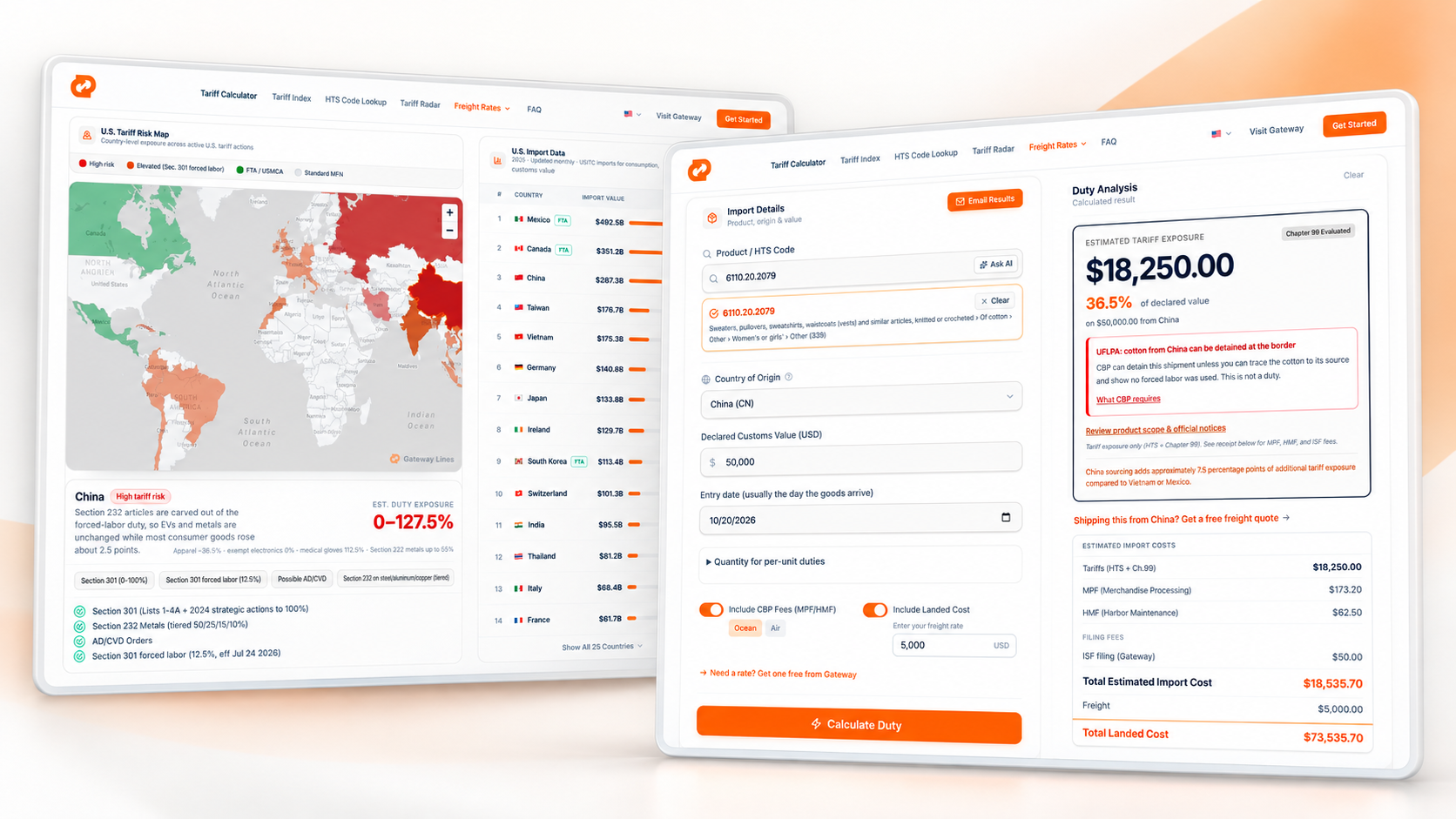
October 20, 2026 | Gateway Lines For retailers and distributors, an import decision can affect product pricing, purchasing budgets and inventory plans. Estimating U.S. import duties begins with understanding the goods, their classification, their country of origin and the tariff measures that apply.
Gateway’s tariff calculator brings that research into one place. The platform combines an import duty calculator, HTS code lookup, sourcing comparisons and published tariff examples to help businesses understand the costs attached to an import decision.
From reviewing a supplier quote to planning a large product order, the platform gives buying and logistics teams a practical way to investigate tariff exposure before goods move. Its public tools connect individual product research with catalog planning.
Explore the Gateway Tariff Calculator.
Tariff planning for retailers and distributors
Big-box retailers, wholesale distributors, manufacturers and e-commerce businesses all face decisions about product cost, sourcing and inventory. Gateway’s tariff calculator supports those decisions with U.S. import duty estimates, HTS code research and country-of-origin comparisons in one accessible platform.
Buying teams can assess the duty implications of a new product range. Distributors can examine import costs before replenishing stock. Manufacturers can investigate tariffs on imported components, while growing brands can review how duties affect a proposed order.
The platform offers starting points for a single product or a broader catalog. Teams can investigate a tariff line, review a published calculation example and choose the appropriate single-product or bulk workflow.
The HTS directory and import duty examples connect those starting points.
Import duty calculations with the tariff layers visible
A useful U.S. tariff calculator needs to account for the facts behind an estimate. The general duty rate is one component. Applicable additional tariffs and government fees can affect the amount an importer needs to budget.
Gateway’s main calculator accepts a product or HTS code, country of origin, customs value and entry date. Where a tariff requires a quantity or unit, those details also matter. The result can identify applicable duty components and, when selected and supported, include Merchandise Processing Fee and Harbor Maintenance Fee estimates.
That breakdown helps an importer understand which charges contribute to the result. It also makes a supplier discussion more productive: a lower purchase price may need to be evaluated alongside a different duty exposure.
For a procurement team, the practical value is a clearer basis for comparing the order under consideration. For a business preparing to ship, it is a starting point for discussing the full movement and its remaining costs.
HTS code lookup connected to the calculation
Product classification is central to an import duty estimate. Descriptions such as “parts,” “furniture” or “electronics” leave important details unresolved. Material, function and construction can affect which classification should be examined.
Gateway’s HTS code lookup combines code search with AI-assisted suggestions to help users investigate possible classifications. The public directory adds a place to review individual tariff lines.
A suggested code still needs to fit the actual goods. Supplier specifications and detailed product information are valuable inputs, particularly when several classifications appear plausible.
Connecting classification research to the tariff calculator helps keep the estimate grounded in the product. Users can investigate the code, enter the relevant origin and value, and review the duty components for that scenario.
A China tariff calculator with a practical example
China import duties illustrate why a product-specific calculation matters. The general tariff schedule and applicable additional measures need to be considered together. A general duty rate of “Free” can still produce a duty bill.
Gateway’s published toys-from-China calculation, priced October 20, 2026, demonstrates the point. The example uses HTS 9503.00.00.90, China origin, a $10,000 customs value and a commercial ocean shipment.
Component | Rate | Estimated amount |
General duty | 0% | $0.00 |
Section 301 forced-labor duty (9903.05.31) | 12.5% | $1,250.00 |
Merchandise Processing Fee | 0.3464% | $34.64 |
Harbor Maintenance Fee | 0.125% | $12.50 |
Duty plus government fees | — | $1,297.14 |
The goods, duties and government fees total $11,297.14 before freight and other charges. The estimate assumes the stated classification and origin are correct and no applicable exception changes the treatment. Rates and eligibility should be checked for the actual entry date.
The additional duty and fee references are published by USTR, CBP and the HMF regulation. The general tariff schedule is available from the USITC.
For someone looking for a China tariff calculator, this is the useful distinction: the calculation needs to show how the relevant charges apply to the particular product and shipment assumptions.
Comparing sourcing options by country of origin
Tariff exposure can influence which supplier offers the stronger commercial proposal. Gateway’s sourcing-comparison feature lets users examine duty estimates across origin scenarios for a product.
That gives procurement teams a way to investigate a genuine sourcing alternative before committing to an order. The duty comparison becomes one input alongside purchase price, supplier capability, lead time and transport costs.
An origin with a lower estimated duty rate may still have a higher overall acquisition cost. Keeping those components visible helps a business identify what needs further investigation before choosing a supplier.
Bulk tariff calculations for product catalogs
Import planning often involves a list of products with different classifications and origins. Gateway’s bulk tariff calculator supports CSV and Excel uploads as well as pasted rows, with downloadable results for further review.
The workflow helps teams examine duty exposure across a catalog and identify items that need closer attention. It also provides a practical bridge between a buying spreadsheet and a product-by-product tariff review.
Bulk calculations currently use the current day’s rules. They exclude MPF, HMF, freight and insurance, so those amounts need to be considered separately. Free estimates are available within the published usage allowances, with account requirements and larger-file access explained in the tool.
Tariff research reaching a wider audience
Gateway’s public tariff resources are also appearing in outside coverage. Tech Times referenced Gateway’s Section 301 analysis in its reporting on Vietnam’s supply chain. WorldShift included the same analysis among the references for a tariff explainer.
These references show Gateway’s tariff analysis being used beyond its own website.
The calculator is also available through the Gateway Tariff Calculator listing in ChatGPT, adding another way to access the tool. Gateway’s AI connection documentation explains the supported functions and access requirements.
Connecting tariff estimates to shipment planning
A tariff estimate is most useful when its scope is clear. Duties, government fees, freight, insurance, brokerage and delivery are separate cost components, and their inclusion depends on the workflow and information entered.
Gateway’s coverage information explains supported calculations and limitations. For products affected by antidumping or countervailing duties, producer-specific or exporter-specific treatment may require further confirmation before an estimate is complete.
The tariff policy log gives readers another place to follow documented changes and review source notices. Keeping the entry date and assumptions alongside an estimate helps teams revisit a calculation when the facts or applicable rules change.
Gateway Lines connects that tariff-planning work to the next commercial step: arranging the shipment. A business can use the estimate to prepare a clearer discussion about the goods, expected duties and logistics services it needs.
Gateway’s tariff calculator brings product classification research, duty estimates and sourcing comparisons into the same planning process. For retailers, distributors and other import businesses, its value comes from applying those resources to the products they intend to buy and ship.
Use the Gateway Tariff Calculator to review a product, compare an origin scenario or start a bulk estimate. When the shipment is ready for planning, connect with Gateway Lines.
Frequently asked questions
Is Gateway’s tariff calculator free?
Yes. Gateway provides a free tariff calculator with published usage limits. Email registration, customer access and higher-volume features have different requirements. The calculator and bulk-upload pages explain the applicable limits.
What information do I need to calculate U.S. import duties?
Start with a detailed product description or HTS code, country of origin, customs value and relevant entry date. Some goods also require quantities, material details or other product-specific inputs. The estimate depends on the accuracy of those facts.
Can I calculate import duties on goods from China?
Yes. Gateway supports China-origin scenarios and can show applicable duty layers for the selected product. The result depends on classification, origin, entry timing and any relevant exceptions. There is no single China duty rate that describes every product.
What is the difference between HTS code lookup and a tariff calculator?
An HTS code lookup helps users investigate product classification and tariff-schedule information. A tariff calculator uses a classification together with origin, value and other inputs to estimate applicable duties and supported fees.
Can I calculate tariffs for multiple products at once?
Yes. Gateway’s bulk tool accepts CSV files, Excel files and pasted product rows. It provides results for catalog review using current-day rules. Government fees such as MPF and HMF, freight and insurance are excluded from that bulk workflow.
Can a tariff calculator replace a customs broker?
A tariff calculator supports planning and budgeting. It does not issue a binding classification decision or replace the review needed for a customs entry. Product classification, exemptions and supplier-specific trade-remedy treatment may require professional confirmation.