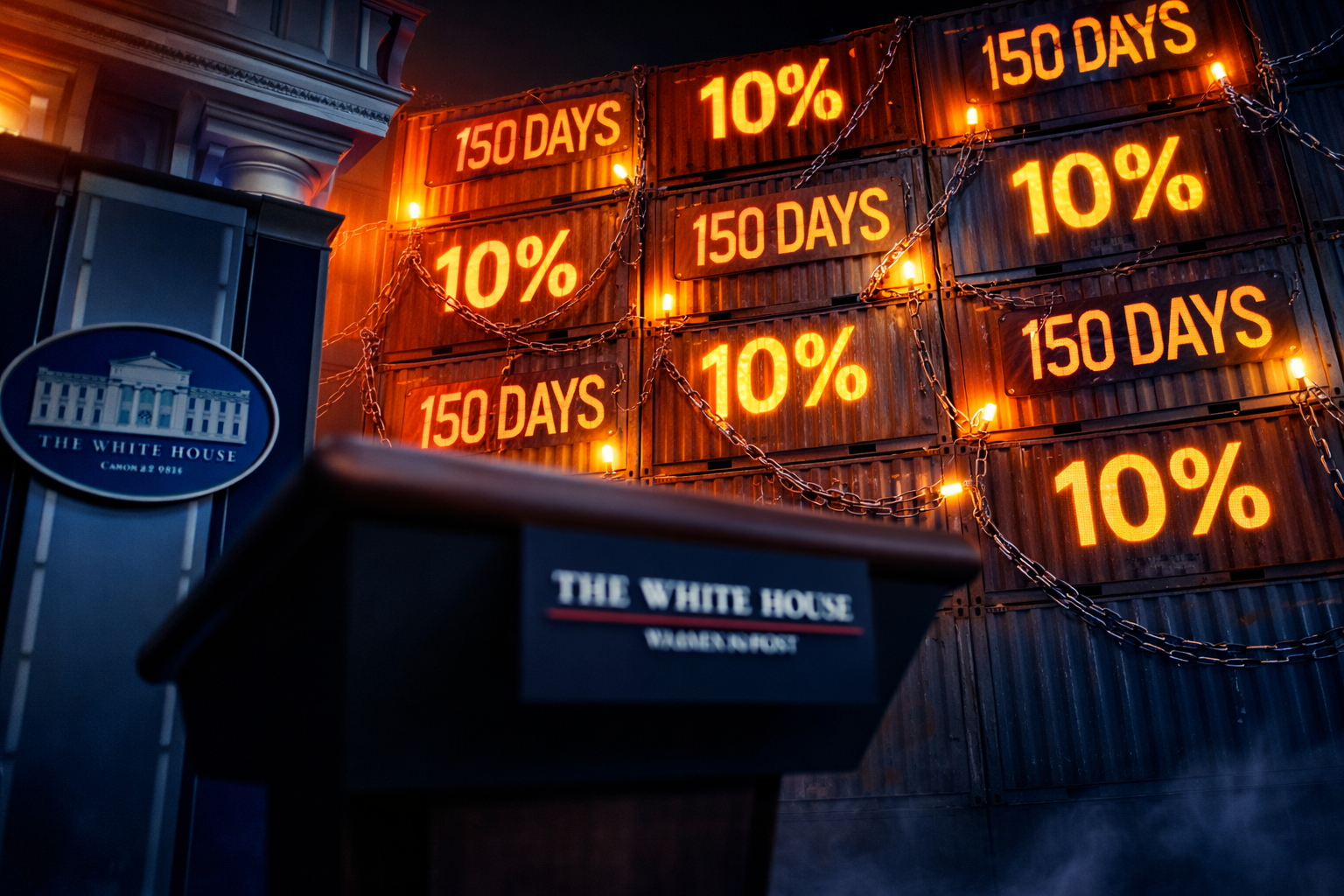
Hours after the Supreme Court handed down its landmark 6-3 decision invalidating most of his tariff agenda, President Trump appeared in the White House briefing room and announced what amounts to Plan B: a 10% global import surcharge under Section 122 of the Trade Act of 1974, a statute that has never been invoked in its 52-year history.
The move signals that while the legal basis for tariffs has shifted, the administration's trade posture has not. Importers who spent the morning celebrating lower duties may now face a new layer of costs — albeit one with hard statutory limits that IEEPA never had.
⚠️ Developing Story
This article reflects information available as of the afternoon of February 20, 2026. The executive order text has not yet been published. Effective dates, product scope, and country exemptions may differ from Trump's remarks. We will update this article as details emerge. Check our tariff calculator for real-time rate updates.
What Trump Announced
Speaking from the White House briefing room at approximately 12:45 p.m. EST, Trump announced two immediate actions in response to the Supreme Court's ruling:
First, he stated he would sign an executive order imposing a 10% global tariff under Section 122 of the Trade Act of 1974. He characterized the surcharge as being "over and above our normal tariffs already being charged," making clear this is a stacking duty, not a replacement for existing tariffs.
Second, he announced the initiation of new investigations under Section 301 of the Trade Act of 1974 "to protect our country from unfair trading practices of other countries and companies." Section 301 investigations, which require formal processes through the U.S. Trade Representative, could take six to nine months before resulting in tariff actions but have no rate cap and no time limit.
Trump called the Supreme Court's decision "deeply disappointing," said he was "ashamed of certain members of the court," and publicly praised the three dissenting justices — Thomas, Alito, and Kavanaugh — by name.
What Is Section 122?
Section 122 of the Trade Act of 1974 (codified at 19 U.S.C. §2132) is a narrow trade authority designed for one specific scenario: when "fundamental international payments problems require special import measures." The statute provides that the president may proclaim a temporary import surcharge under three conditions:
The United States faces "large and serious" balance-of-payments deficits; there is an "imminent and significant" depreciation of the dollar in foreign exchange markets; or the measure is needed to cooperate with other countries in correcting an international balance-of-payments disequilibrium.
Section 122 at a Glance
Rate cap: 15% ad valorem, maximum. Trump announced 10%.
Duration: 150 days unless Congress extends it.
Investigation required: None. No agency fact-finding needed.
Prior use: Zero. No president has ever invoked this authority.
Original intent: Emergency balance-of-payments tool designed during the Bretton Woods era.
Key distinction from IEEPA: Congress explicitly authorized tariffs here, with hard limits on rate and duration.
The critical distinction between Section 122 and the now-invalidated IEEPA authority is that Congress specifically authorized tariffs under Section 122, using the word "duties" directly in the statute. The Supreme Court's ruling today emphasized that IEEPA "contains no reference to tariffs or duties." Section 122 does. That is a meaningful legal difference.
However, the statutory constraints are severe. A 15% rate cap means the administration cannot replicate the 20-50% reciprocal tariff rates that IEEPA enabled. The 150-day limit means this is inherently temporary — a bridge, not a permanent policy. And the balance-of-payments trigger is a specific economic condition, not a catch-all emergency declaration.
How Section 122 Compares to Other Tariff Authorities
Authority Rate LimitTime Limit Investigation Status:
IEEPA None None None Struck down
Section 122 15% 150 days None New — announced today Section 232 None None Commerce Dept.Active (steel, aluminum, autos, copper, lumber)
Section 301 None 4 years (renewable) USTR Active (China 7.5-25%); new investigations announced
Section 201 None 4 years (renewable) ITC Not currently invoked
Section 338 50%None None Never used; being discussed
What This Means for Importers: Tariff Stacking
Trump stated the 10% surcharge applies "over and above" existing duties. If implemented as described, here is how tariffs would stack for common scenarios:
China (electronics, machinery, consumer goods)
Base MFN duty (varies by HTS code) + Section 301 (7.5-25%) + Section 122 (10%) = significantly higher than pre-SCOTUS rates for some products. A laptop from China that carried a 25% Section 301 tariff could now face 35% in special duties alone, plus the MFN base rate. Under IEEPA, the reciprocal rate was 10% (under the November 2025 truce), so some Chinese goods may actually see higher duties under the new regime.
European Union, Japan, South Korea
These countries had 10-20% IEEPA reciprocal tariffs that were struck down today. The new 10% Section 122 surcharge partially replaces that layer. For goods not subject to Section 232, importers will see roughly similar rates to the IEEPA baseline but without the country-specific differentials.
Vietnam, India, Thailand, Indonesia
These countries had among the highest IEEPA reciprocal rates (26-46%). The 10% Section 122 surcharge is substantially lower. Importers from these origins will still see meaningful relief compared to yesterday's rates, even with the new surcharge.
Canada and Mexico
The fentanyl IEEPA tariffs (25% on Mexico, 25% on Canada for non-USMCA goods, 20% on China) were struck down. A blanket 10% Section 122 surcharge would hit USMCA-compliant goods that were previously exempt under the fentanyl tariff structure. However, it remains unclear whether USMCA or other trade agreement exemptions will apply to the Section 122 surcharge.
Importers: Key Unknowns
The executive order text has not been published. Critical open questions include: Does the surcharge apply to all HTS codes or are there exemptions? Are USMCA, CAFTA-DR, and other FTA partners excluded? Does it stack on Section 232 products or replace existing surcharges? What is the effective date — immediate, or after Federal Register publication? Will CBP issue implementation guidance, or is this treated as a Chapter 99 entry? These details will determine the actual cost impact.
Legal Vulnerabilities
While Section 122 has stronger textual footing than IEEPA — it explicitly mentions "duties" — the administration's use of it faces several legal challenges that trade lawyers are already flagging:
The Balance-of-Payments Requirement
Section 122 requires "fundamental international payments problems" involving "large and serious" balance-of-payments deficits or "imminent and significant" depreciation of the dollar. The United States runs a persistent trade deficit in goods, which the administration will cite. However, the U.S. also runs a services surplus, the dollar has been relatively strong (not depreciating), and the concept of a "balance-of-payments crisis" typically refers to currency crises of the kind that plagued developing nations under the Bretton Woods system - not the structural trade patterns of the world's reserve currency issuer.
Historical Context
The fact that no president has ever invoked Section 122 in 52 years, despite persistent trade deficits, cuts both ways. The administration may argue the deficits now qualify; challengers will note that if this were a valid use case, some president would have used it already. The Supreme Court relied heavily on this "historical gloss" argument in today's IEEPA ruling, writing that the absence of prior use "is strong evidence that [the power] does not exist."
The 150-Day Clock
Even if Section 122 survives legal challenge, it expires in 150 days unless Congress acts to extend it. The current Congress has shown no appetite for broad tariff legislation — the Senate has already voted to rebuke Trump's tariffs on Canada. This creates a hard deadline around mid-July 2026 where the surcharge either lapses or triggers a political fight on Capitol Hill.
Interaction with Trade Agreements
Applying a blanket surcharge to all imports, including from countries with which the U.S. has free trade agreements (USMCA, Australia, Singapore, etc.), could raise WTO consistency issues and breach treaty obligations. The statute itself contains a provision that no surcharge shall be imposed in a way that violates existing trade agreement obligations, which could limit its scope significantly.
The Section 301 Investigations: The Long Game
While Section 122 is the immediate headline, the Section 301 investigations announced today represent the administration's long-term tariff strategy. Section 301 allows the U.S. Trade Representative to investigate and impose retaliatory tariffs against foreign practices deemed "unjustifiable," "unreasonable," or "discriminatory." There is no rate cap on Section 301 tariffs, and they can be renewed for four-year periods.
Trump used Section 301 extensively during his first term to impose the original China tariffs (still in effect at 7.5-25%), and the current administration has been using Section 301 for shipbuilding-related tariffs. New investigations could target automotive imports, pharmaceuticals, semiconductors, agricultural practices, or digital trade barriers — but the investigation process typically takes six to nine months before tariff action can be taken.
This creates a two-phase strategy: Section 122 as a 150-day bridge to maintain tariff pressure while Section 301 investigations generate the legal basis for more permanent tariff actions.
What Remains in Effect: The Complete Tariff Picture
After today's Supreme Court ruling and the new Section 122 announcement, here is the complete tariff landscape as of this evening:
Tariff Category Rate Authority Status:
Steel imports 25% Section 232Active
Aluminum imports 25% Section 232Active
Automobiles & parts 25% Section 232 Active
Copper (semi-finished) 25% Section 232 Active
Lumber 25% Section 232 Active
China (various goods) 7.5-25% Section 301 Active
Global surcharge (NEW) 10%Section 122 Announced — pending EO
Liberation Day reciprocal tariffs 10-50% IEEPA Struck down
Fentanyl tariffs (CN/MX/CA) 20-25% IEEPA Struck down
Country-specific IEEPA (India, Brazil, etc.) 10-50%IEEPA Struck down
Timeline: From IEEPA to Section 122
February 1, 2025
Trump invokes IEEPA for the first time to impose tariffs, citing fentanyl trafficking emergency. 25% on Mexico, 25% on Canada, 10% on China.
April 2, 2025 — "Liberation Day"
Reciprocal tariffs announced: 10% baseline on nearly all countries, with rates up to 50% for specific trading partners.
May 28, 2025
Court of International Trade rules IEEPA tariffs exceed presidential authority in V.O.S. Selections case.
August 29, 2025
Federal Circuit affirms lower court ruling against IEEPA tariffs. Administration appeals to Supreme Court.
November 2025
Supreme Court hears oral arguments in consolidated Learning Resources v. Trump / V.O.S. Selections v. Trump.
February 20, 2026 — 10:03 AM EST
Supreme Court rules 6-3 that IEEPA does not authorize tariffs. All IEEPA-based tariffs invalidated immediately.
February 20, 2026 — 12:45 PM EST
Trump announces 10% global tariff under Section 122 and new Section 301 investigations. Executive order signing expected same day.
*July 2026 (projected)
Section 122 surcharge expires at 150-day mark unless extended by Congress. Section 301 investigations may produce initial findings.
Economic Impact: Yale Budget Lab Analysis
The Yale Budget Lab published updated analysis on the same day, modeling the post-SCOTUS tariff landscape. With only Section 232 and Section 301 tariffs remaining, consumers face an average effective tariff rate of 9.1% — still the highest since 1946, but significantly lower than the 16.9% rate with IEEPA tariffs in force.
If the Section 122 surcharge at 10% is applied broadly without exemptions, Yale Budget Lab estimates the effective tariff rate could rise to approximately 20%, potentially exceeding the IEEPA-era rate if applied to products that previously had exemptions. At the maximum 15% rate, the effective rate could reach 24.1%.
The household-level impact under the current post-SCOTUS regime (before Section 122) is estimated at approximately $800 for the average household and $400 for households at the bottom of the income distribution. The Section 122 surcharge would add to these figures, though the exact amount depends on product scope and exemptions.
The Tax Foundation estimates that the now-invalidated IEEPA tariffs raised more than $160 billion for the federal government and would have generated $1.4 trillion over the next decade. The Section 232 tariffs that remain are projected to raise $635 billion over the same period.
What Importers Should Do Now
Immediate Actions
1. Monitor the Federal Register. The executive order text and CBP implementation guidance will determine actual effective dates and product scope. Do not adjust shipment timing until the EO is published.
2. Review your tariff exposure. Use the Gateway Lines Tariff Calculator to model your costs under the current regime. We will update the calculator once CBP guidance is issued.
3. Assess the 150-day window. Section 122 expires in approximately five months. For large orders, consider whether delaying shipments past the expiration date is commercially viable.
4. Pursue IEEPA refunds. The Supreme Court's ruling means previously collected IEEPA tariffs were illegal. File protests with CBP or consult a customs attorney about the refund process. The 2-year statute of limitations applies.
5. Watch Section 301 announcements. New investigations will target specific sectors. If your product category is named in a Section 301 investigation, tariff increases of 25% or more could follow in 6-9 months.
Calculate Your Updated Tariff Exposure
Our tariff calculator reflects all post-SCOTUS changes in real time. Model your costs under the current regime and prepare for Section 122 implementation.
Looking Ahead: The New Trade Policy Landscape
Today's events represent a fundamental restructuring of how the United States imposes tariffs. The era of unconstrained presidential tariff authority under IEEPA is over. What replaces it is a patchwork of authorities, each with its own constraints, timelines, and legal vulnerabilities.
Section 122 gives the administration approximately five months of runway at a reduced rate. Section 301 investigations could produce longer-term authorities with no rate cap, but only after months of formal process. Section 232 remains the most durable tool, but expanding it to new product categories requires Commerce Department investigations.
For importers, the message is clear: tariffs are not going away, but they are becoming more constrained, more predictable, and more legally vulnerable. The Supreme Court's ruling today established that Congress, not the president, controls tariff policy. Every new tariff action will now be tested against that precedent.
The next 150 days will determine whether Section 122 survives legal challenge, whether Congress acts to extend or replace it, and whether Section 301 investigations produce the administration's next tariff framework. We will continue to update our analysis and calculator as developments unfold.
Gateway Lines Tariff Team Is Closly Monitoring and providing live time updates to Tariff and its Tariff Simulator
Sources
NBC News, "Live updates: Trump calls Supreme Court tariff ruling 'deeply disappointing,' vows new tariffs under separate law," February 20, 2026. nbcnews.com
CBS News, "Watch Live: Trump holds news conference in wake of Supreme Court tariff decision," February 20, 2026. cbsnews.com
Congressional Research Service, "Congressional and Presidential Authority to Impose Import Tariffs," R48435. congress.gov
19 U.S.C. §2132 — Balance-of-payments authority (Section 122 statutory text). uscode.house.gov
Yale Budget Lab, "State of U.S. Tariffs: February 20, 2026." budgetlab.yale.edu
Tax Foundation, "Supreme Court Trump Tariffs Ruling: Analysis," February 20, 2026. taxfoundation.org
NPR, "7 key things to know about Trump's tariffs after the Supreme Court decision," February 20, 2026. npr.org
CNBC, "Supreme Court strikes down Trump tariffs, rebuking president's signature economic policy," February 20, 2026. cnbc.com
ING Think, "Supreme Court pulls plug on Trump's IEEPA tariffs," February 2026. think.ing.com
U.S. News, "Trump Has Other Tariff Options After Supreme Court Strikes Down His Worldwide Import Taxes," February 20, 2026. usnews.com