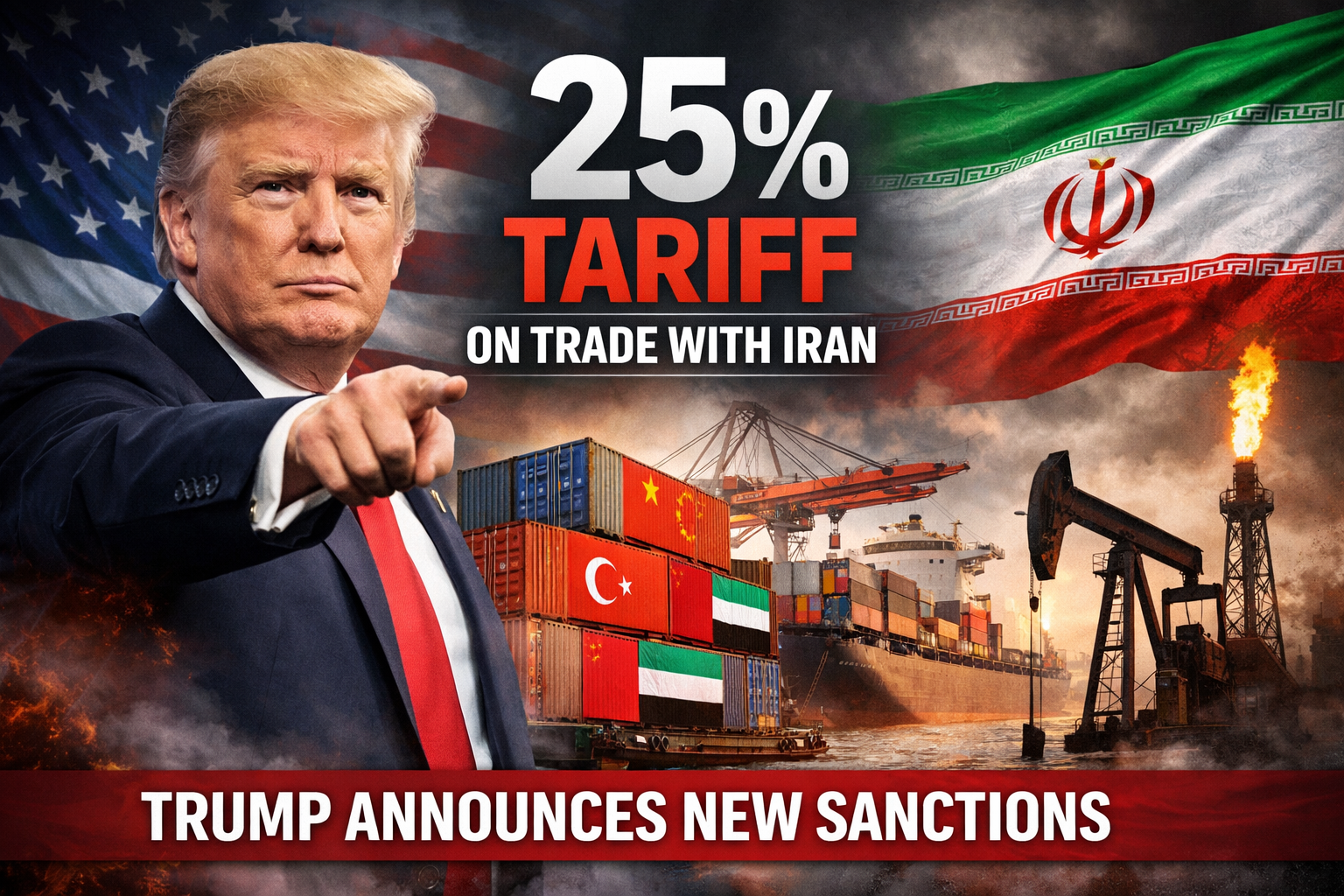
January 13, 2026 — President Donald Trump has announced a new and sweeping tariff policy that would impose a 25 percent tariff on any country that conducts trade with the Islamic Republic of Iran. The measure, posted on Trump’s social platform and described as “effective immediately” and “final,” marks a significant escalation in U.S. economic pressure tied to Iran’s ongoing domestic unrest and geopolitical tensions.
Under the announcement, countries that maintain economic relationships with Iran — including trading of goods, energy exports, or other commercial activities — would face elevated levies on all goods and potentially services exported to the United States. Trump’s statement did not define precisely what activities will qualify as “doing business” with Iran, leaving enforcement details and legal authority unclear.
The move comes amid widespread protests within Iran, which have drawn international attention and condemnation as Iranian authorities crack down on dissent. Trump and senior U.S. officials have publicly tied this tariff threat to a broader strategy aimed at pressuring Tehran’s government.
Global Trade and Diplomatic Reactions
Major global trade partners with Iran — such as China, India, the United Arab Emirates, Turkey, and Iraq — could be significantly affected. China, Iran’s largest trading partner, criticized the tariff policy and warned it would take steps to protect its interests, noting that “there are no winners in a tariff war.” Beijing’s response underscores the risk of renewed friction in U.S.–China relations, which were already strained under previous tariff disputes.
The Indian government, with comparatively lower levels of trade with Iran, has indicated that the 25 percent tariff is likely to have a minimal economic impact on its economy, reflecting variations in trade exposure across countries.
Analysts warn that these tariffs — if interpreted literally — could lead to broad trade implications, raising costs for American importers and potentially igniting retaliatory duties from affected nations. The ambiguity around how the tariffs will be implemented, and under what legal authority, has sparked debate among trade experts and legal scholars.
Economic Ripple Effects
Financial markets have already reacted. Oil prices rose in the immediate aftermath of the announcement, trading at multi-month highs as traders priced in the potential disruption to global energy markets and heightened geopolitical risk
The broad scope of this tariff strategy has drawn comparisons to past U.S. trade actions that targeted not just direct adversaries but also nations with indirect commercial links. Without further clarification from the White House, however, many questions remain about enforcement mechanisms, exemptions for humanitarian or limited trade, and how the policy will intersect with existing sanctions regimes.
Outlook and Uncertainty
While the White House continues to emphasize diplomatic channels as part of the overall U.S. approach to Iran, this tariff directive represents one of the most aggressive economic measures adopted in response to Iran in recent years. The policy’s immediate effects and long-term implications for global trade relationships — particularly between the U.S., China, and other major economies — will depend on how governments interpret and react to the tariff threat in the coming weeks.