
One year after the original Liberation Day tariff announcements, President Trump signed two major Section 232 proclamations on April 2, 2026, fundamentally restructuring how the United States taxes imported metals and pharmaceuticals.
The metals overhaul takes effect April 6, 2026. The pharmaceutical tariffs begin phasing in on July 31, 2026. Together, these actions represent the most significant changes to U.S. trade policy since the Supreme Court struck down IEEPA tariffs in February.
If you import steel, aluminum, copper, or pharmaceutical products into the United States, your landed cost calculations just changed. Here is everything you need to know.
What Changed: Section 232 Metals Overhaul
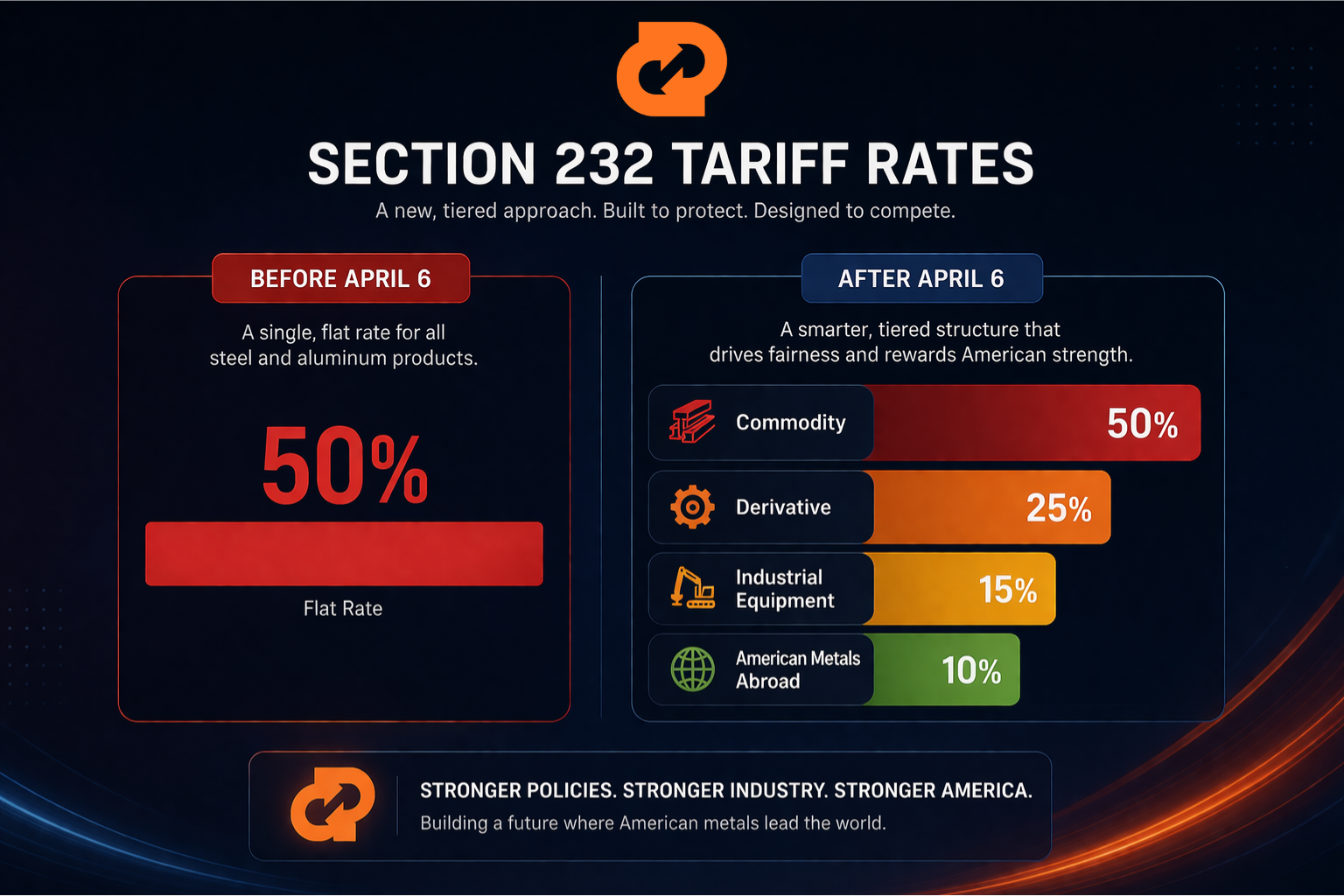
The previous metals tariff structure was straightforward but blunt: 50% on virtually everything classified as steel, aluminum, or copper under Section 232. That flat rate applied whether you were importing raw steel coils or a finished tractor part that happened to contain steel components.
The April 2 proclamation replaces that system with a tiered structure based on how much metal content a product contains. The new rates take effect at 12:01 AM Eastern on April 6, 2026.
New Tiered Rate Structure
Commodity metals — 50% ad valorem
Products made entirely or almost entirely of steel, aluminum, or copper. This includes raw materials like steel coils, aluminum sheet, copper cathode, and similar commodity-grade imports. The rate stays at 50%, but with a critical change: duties will now be assessed on the U.S. sales price of the metal, not the declared import value. This closes a loophole where importers were declaring artificially low customs values to reduce their duty exposure.
Derivative products — 25% ad valorem
Products that contain substantial amounts of steel, aluminum, or copper but are not pure commodity metal. This covers a massive range of manufactured goods — everything from tractor parts and stainless steel sinks to railroad equipment and construction hardware. This is a significant reduction from the previous 50% rate and will lower costs for manufacturers and distributors importing finished or semi-finished metal products.
Industrial and electrical grid equipment — 15% through 2027
Certain metal-intensive industrial equipment and electrical grid infrastructure components will pay a reduced 15% rate through 2027. This carve-out is designed to accelerate domestic industrial buildout without penalizing companies that need heavy equipment imports to expand U.S. manufacturing capacity.
Products made abroad with American metals — 10%
If a product is manufactured overseas but uses steel, aluminum, or copper that originated in the United States, the tariff drops to 10%. This incentivizes foreign manufacturers to source American metals even when final assembly happens abroad.
United Kingdom Preferential Rates
Under an existing bilateral agreement, the UK receives preferential Section 232 treatment:
UK commodity metals (smelted or cast in the UK): 25% instead of 50%
UK derivative products: 15% instead of 25%
Valuation Change: US Sales Price vs. Declared Value
This is the change that will catch the most importers off guard. Previously, Section 232 duties were calculated on the declared customs value — the price the importer reported on their entry documentation. The new proclamation shifts the basis to the U.S. sales price for metals.
The administration's stated rationale is that declared import values were often kept artificially low, reducing the effective tariff rate below what was intended. By tying duties to the domestic sales price, the government ensures the tariff reflects the true market value of the metal.
For importers, this means your Section 232 duty calculation may increase even on product categories where the percentage rate dropped. A derivative product that previously paid 50% on a low declared value might now pay 25% on a higher sales-price basis — and the total dollar amount could be similar or even higher depending on the markup.
What to do: Review your metals import entries from the past 90 days and model the new rates against both your declared values and your U.S. sales prices. Gateway's tariff calculator has been updated to reflect the new tiered structure.
What Changed: Section 232 Pharmaceutical Tariffs
This is entirely new territory. For the first time, the United States is imposing Section 232 national security tariffs on pharmaceutical imports. The proclamation follows a Commerce Department investigation led by Secretary Howard Lutnick that determined pharmaceutical imports threaten national security due to America's dependence on foreign drug manufacturing.
The Rate Structure
Patented pharmaceuticals: 100% ad valorem
Any patented drug or associated pharmaceutical ingredient that does not have a deal with the U.S. government will face a 100% tariff. This effectively doubles the cost of importing these products.
Companies with approved onshoring plans: 20%
Pharmaceutical companies that submit and receive approval for plans to build manufacturing facilities in the United States will pay a reduced 20% rate during the construction period. After four years, the rate reverts to 100% if onshoring is not complete.
Companies with MFN pricing and onshoring commitments: 0%
Companies that agree to offer Most-Favored-Nation pricing (matching the lowest price they charge in any country) AND commit to building U.S. manufacturing capacity will pay zero tariffs. This is the carrot alongside the 100% stick.
Generic pharmaceuticals: Exempt
Generic drugs and biosimilar products are not subject to Section 232 pharmaceutical tariffs at this time. The Commerce Secretary will review this exemption within one year.
Timeline
The pharmaceutical tariffs do not take effect immediately:
Large pharmaceutical companies: July 31, 2026 (120 days from signing)
Smaller pharmaceutical companies: September 29, 2026 (180 days from signing)
This grace period gives companies time to negotiate deals with the administration. Thirteen major pharmaceutical companies — including Pfizer and Eli Lilly — have already signed agreements and will not face the 100% rate.
Who Is Affected
The pharmaceutical tariff primarily impacts companies importing patented brand-name drugs and their active pharmaceutical ingredients (APIs). HTS Chapters 29 (organic chemicals, including APIs) and 30 (pharmaceutical products) are the most directly affected.
If you import generic drugs, over-the-counter medications, or biosimilars, you are currently exempt. However, the one-year review clause means this exemption could change.
What Hasn't Changed
Not everything shifted on April 2. Here is what remains the same:
Section 301 China tariffs remain in effect at their current rates (7.5% to 25% depending on the product list). The November 2025 U.S.-China agreement reduced fentanyl-related tariffs from 20% to 10% and is extended through November 2026.
Section 122 global tariff remains at 10% on most imports, effective February 24, 2026. The 150-day expiration deadline is July 24, 2026. The administration announced an increase to 15% but no formal Executive Order has been issued. Twenty-four states are suing to block Section 122 entirely.
IEEPA tariffs remain struck down following the Supreme Court's 6-3 ruling on February 20, 2026. CBP is building ACE functionality to process refunds, expected mid-April. If you paid IEEPA duties, check your refund eligibility using our free estimator at tariff.gatewaylines.com/ieepa-refund.
Section 232 auto tariffs remain at 25% on assembled vehicles and certain parts. The U.S.-Japan deal reduced auto tariffs on Japanese imports to 15% effective September 2025.
How Tariffs Stack in 2026
One of the most confusing aspects of the current tariff environment is how multiple duties stack on a single import. Here is how it works for common scenarios after April 6:
Steel Product from China (Commodity)
Base MFN duty: varies by HTS (0-12%)
Section 301 China: up to 25%
Section 232 metals: 50% (on US sales price)
Section 122 global: excluded (Section 232 applies)
Aluminum Derivative Product from Germany
Base MFN duty: varies by HTS
Section 232 metals: 25% (derivative rate, on US sales price)
Section 122 global: excluded (Section 232 applies)
Patented Drug from Ireland (No Deal)
Base MFN duty: varies by HTS
Section 232 pharma: 100% (effective July 31)
Section 122 global: excluded (Section 232 applies)
Consumer Electronics from China
Base MFN duty: varies by HTS
Section 301 China: 7.5-25%
Section 122 global: 10%
Section 232 metals: not applicable
The key rule: Section 122 does not apply to products already covered by Section 232. So metals and pharmaceuticals pay their Section 232 rate but not the additional 10% Section 122 surcharge.
What Importers Should Do Right Now
1. Reclassify Your Metals Imports
The tiered structure means the difference between "commodity" and "derivative" classification could save you 25 percentage points on every entry. Review your HTS codes and product descriptions to ensure you are classified in the correct tier. If your product is a derivative, you should be paying 25%, not 50%.
2. Model the Valuation Change
The shift from declared customs value to U.S. sales price for metals will change your effective duty rate even if the percentage dropped. Run the numbers on your top-volume metals products to understand your new landed cost.
3. Check Your Pharmaceutical Exposure
If you import any products under HTS Chapters 29 or 30, determine whether they are patented or generic. Patented products will face 100% duties starting July 31 unless you have a deal with the administration. Generics are currently exempt.
4. Review Your IEEPA Refund Eligibility
The Supreme Court struck down IEEPA tariffs in February. CBP refund processing is expected to go live in mid-April. If you paid IEEPA duties on any entries, you may be owed a refund.
Use Gateway's free IEEPA refund estimator: tariff.gatewaylines.com/ieepa-refund
5. Calculate Before You Book
With tariffs shifting, surcharges stacking, and freight rates climbing due to the Strait of Hormuz crisis, your total landed cost can change dramatically from week to week. Calculate your full duty exposure before committing to a shipment.
Use Gateway's free tariff calculator: tariff.gatewaylines.com
6. Lock In Your Ocean Freight Rate
Freight rates are volatile. If you are importing metals, pharmaceuticals, or any goods from Asia, get a rate comparison on your busiest lane before the next round of surcharges hits.
Check your rate instantly with Gateway Rate Pulse: gatewaylines.com/direct-rates
The Bigger Picture
The April 2 proclamations are part of a broader pattern. Since taking office, the Trump administration has used Section 232 as its primary tariff tool — first for steel and aluminum, then autos, then copper, and now pharmaceuticals. With ongoing Section 232 investigations into semiconductors, critical minerals, aircraft, drones, and medical equipment, more industries could face similar treatment in the coming months.
At the same time, the Strait of Hormuz crisis continues to disrupt global shipping lanes, driving up freight costs and extending transit times. The combination of rising tariffs and rising freight rates is squeezing importers from both sides.
For a full analysis of the Hormuz situation and its impact on shipping, read our briefing: The Strait of Hormuz Crisis: What Shippers Need to Know Right Now
Gateway Tariff Tools — Free for All Importers
Tariff Calculator: Calculate duties across Section 301, Section 232, and Section 122 with real-time policy intelligence. → tariff.gatewaylines.com
IEEPA Refund Estimator: Upload your CF-7501 entry and instantly see how much you may be owed. → tariff.gatewaylines.com/ieepa-refund
HTS Code Lookup: Search 30,000+ product classifications with AI-powered matching. → tariff.gatewaylines.com/hs-code-search
Rate Pulse: Get an instant ocean freight rate on any lane, powered by real carrier data and machine learning. → gatewaylines.com/direct-rates
Strait of Hormuz Live Tracking: Monitor global vessel movements in real time. → gatewaylines.com/marine-traffic