If you ship a few pallets at a time from China, Vietnam or India, the question is simple: what do Asia to US LCL rates look like right now? Here is what our LCL rate board showed on November 2, 2026. Every price below is a spot estimate for 1 CBM, CFS to CFS. Spot rates change from sailing to sailing and we confirm the price at booking, so check the live tool for today's number on your lane.
Asia to US LCL rates at a glance
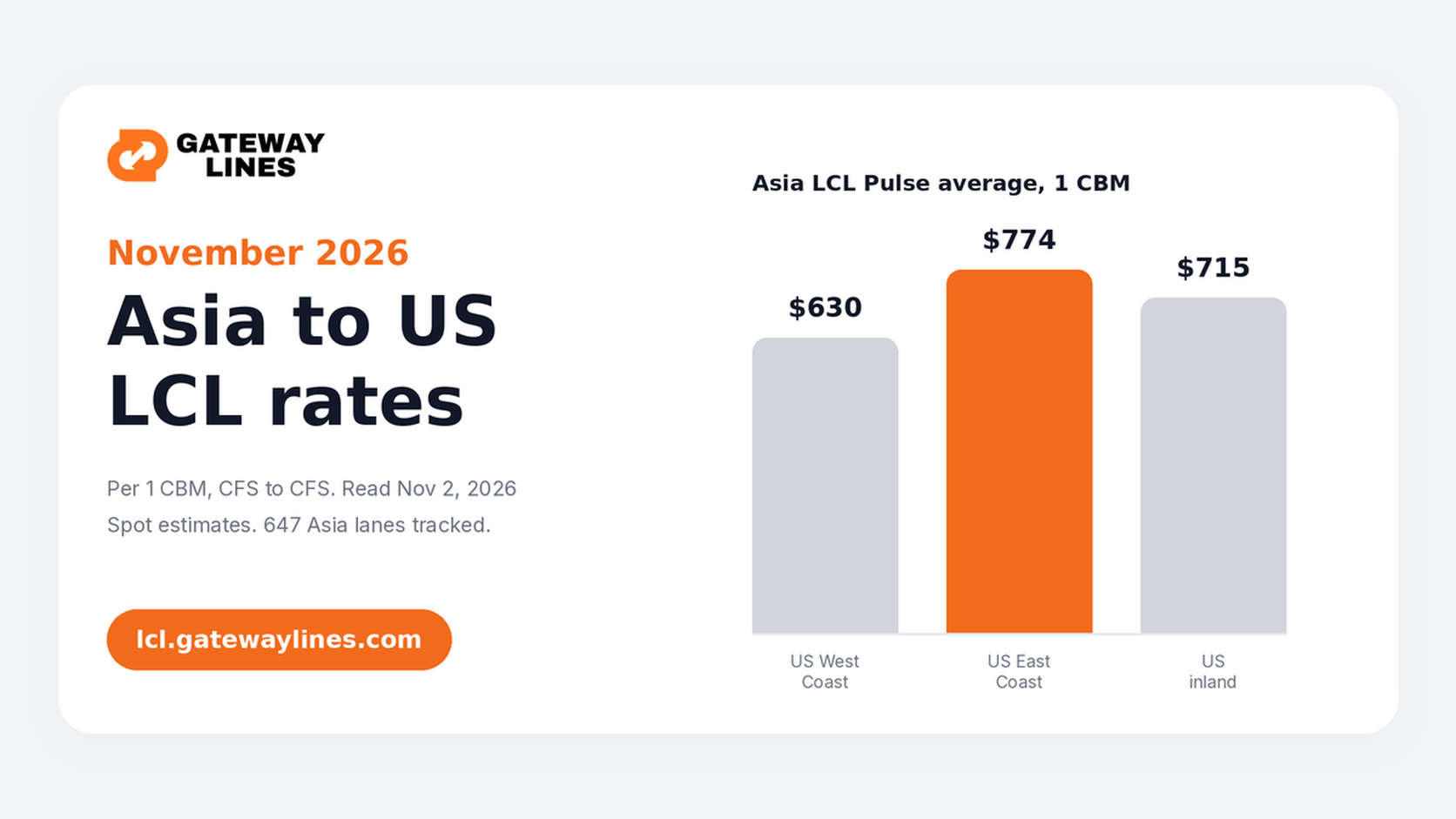
The board's "LCL Pulse" groups Asia lanes by US destination region. On November 2, 2026, it read:
Asia to | Average, 1 CBM | Range | Lanes |
|---|---|---|---|
US West Coast | $630 | $483 to $976 | 122 |
US East Coast | $774 | $608 to $969 | 302 |
US inland | $715 | $544 to $1,044 | 223 |
What stands out:
The West Coast is the cheapest Asia option on average, about $144 less per CBM than the East Coast.
Inland is not always the priciest. Asia to inland points averaged less than the East Coast, though the inland range runs highest at the top.
Ranges are wide. Within one region, lanes differ by several hundred dollars. The average shows the market. Your lane sets your price.
For comparison, Europe and the Med to the US averaged $676 per CBM across 405 lanes. In total the board tracked 1,191 lanes from 82 origin ports to 16 US CFS points. This is one reading, not a trend line.
Asia origins: lane by lane
Here are popular Asia to US LCL lanes as listed on the board on November 2, 2026. Three lanes show their price openly. The rest need a free price reveal on the rate tool, so we list only their transit time and next sailing.
Lane | Transit (cut off to arrival) | Next sailing | 1 CBM, CFS to CFS |
|---|---|---|---|
Shanghai to Los Angeles | 18 days | Nov 8 | $501.82 |
Shanghai to Chicago | 28 days | Nov 8 | $622.71 |
Shanghai to New York | 30 days | Nov 7 | $651.37 |
Shanghai to Savannah | 32 days | Nov 7 | Reveal on tool |
Ningbo to Los Angeles | 24 days | Nov 12 | Reveal on tool |
Shenzhen to Los Angeles | 24 days | Nov 10 | Reveal on tool |
Ho Chi Minh City to Los Angeles | 27 days | Nov 8 | Reveal on tool |
Bangkok to Los Angeles | 31 days | Nov 11 | Reveal on tool |
Haiphong to New York | 38 days | Nov 11 | Reveal on tool |
Nhava Sheva to New York | 38 days | Nov 15 | Reveal on tool |
Asia origins on the board include Chinese ports such as Shanghai, Ningbo, Shenzhen, Guangzhou, Qingdao, Xiamen, Dalian, Fuzhou and Xingang, plus Hong Kong, Vietnam, India, Bangladesh, Cambodia, Indonesia, Malaysia, Thailand, Taiwan, Japan, South Korea, Singapore, Sri Lanka, Pakistan and the Philippines. US CFS points are Atlanta, Baltimore, Boston, Charleston, Chicago, Dallas, Denver, Detroit, Houston, Los Angeles, Miami, New York, Philadelphia, San Francisco, Savannah and Seattle. Not every origin serves every CFS.
West Coast or East Coast?
Shanghai to Los Angeles took 18 days on the board, against 30 days to New York, and cost $149.55 less for 1 CBM. The East Coast can still make sense if your customers or warehouse are there, because delivery from the CFS to your door is a separate cost.
Why 1 CBM costs what it does: a Shanghai to Los Angeles breakdown
You will see LCL quoted elsewhere as an ocean rate per CBM that looks much lower than the numbers above. Usually that is ocean freight only, before CFS and port charges. Our board shows the price for 1 CBM with the destination CFS and port charges included, which is closer to what you actually pay to get cargo to a US warehouse door.
The Shanghai to Los Angeles price of $501.82 covers 1 CBM up to 1,000 kg. Its breakdown includes lines like these:
Origin and ocean
Ocean freight: $208
Emergency bunker: $6
IMO2020: $3
Destination CFS
CFS loading: $50
Labor and transportation: $35.82
Fuel surcharge: $17
Facility: $7
Chassis: $6
Pier pass: $4
Chassis split: $3
Clean truck: $2
That is a partial list, so these lines do not add up to the total. The point is the shape. On a 1 CBM shipment, ocean freight is well under half the bill. Destination charges carry their own minimums, and several are flat per shipment. That is why small shipments pay mostly minimums, and why your cost per CBM usually falls as the shipment grows. To see every line for your lane, price your shipment with your real volume and weight.
How LCL pricing works
Weight or measure (W/M)
LCL ocean freight is charged per revenue ton: 1 cubic meter or 1 metric ton (1,000 kg), whichever is greater. So 3 CBM weighing 800 kg bills as 3 revenue tons, while a dense 2 CBM pallet weighing 2,500 kg bills as 2.5.
How to calculate CBM
Multiply length by width by height in centimeters and divide by 1,000,000 to get CBM per carton. Then multiply by the number of cartons. A 60 by 40 by 40 cm carton is 0.096 CBM, so 100 cartons is 9.6 CBM. Measure the loaded pallet, not just the boxes.
What the board price covers
Ocean freight from the origin CFS to the US destination CFS, plus the destination CFS and port charges in the breakdown. It does not include:
Pickup at your supplier and origin CFS charges, usually paid by the supplier under FOB terms
Delivery from the US CFS to your door
ISF filing, US customs entry and duties
Cargo insurance
Extra charges for hazardous, oversized or non-stackable cargo
Learn more about the service on our LCL consolidation page.
How long LCL takes from Asia
Transit on the board runs from cargo cut off at the origin CFS to arrival in the US. On November 2 it ranged from 18 days (Shanghai and Busan to Los Angeles) to 55 days (Ningbo to New York) among the lanes listed. After arrival, the container is devanned, meaning unloaded at the destination CFS and split into individual shipments. Cargo is usually available at the destination warehouse a few days after arrival, so add that to your plan.
When LCL beats a full container
LCL usually wins when your shipment is too small to fill a container. A common rule of thumb puts the break even point somewhere around 13 to 15 CBM, but it moves with the lane and the week.
A full container often wins as volume climbs, when goods are fragile and you want fewer touches, or when you want to skip consolidation and devanning time. Near the line, price both: check the LCL lane on the rate board, then ask us for a full container quote.
Customs on LCL shipments from Asia
ISF applies to LCL. The Importer Security Filing, or "10+2," covers ocean cargo bound for the US, including LCL. Under 19 CFR Part 149, the importer must file with U.S. Customs and Border Protection no later than 24 hours before the cargo is loaded at the foreign port. CBP explains it on its ISF page.
Duty is a separate cost. Find a likely code with our HS code search, then estimate duty with our duty tool. Rules on goods from China and other Asian countries change often, so watch Tariff Radar before you book.
Frequently asked questions
How much does LCL shipping cost per CBM from China to the USA?
On November 2, 2026, Shanghai to Los Angeles was $501.82 for 1 CBM, CFS to CFS, Shanghai to Chicago $622.71 and Shanghai to New York $651.37. Asia to US West Coast lanes averaged $630. These are spot estimates and change by sailing.
Why do some LCL quotes look much cheaper per CBM?
Many quotes show ocean freight only. Destination CFS and port charges, several of them flat per shipment, come on top. Our board includes those destination charges in the 1 CBM price.
Is there a minimum charge for LCL?
Yes, in practice. Destination CFS and port charges each carry their own minimum, so a shipment under 1 CBM still pays close to the 1 CBM price.
How long does LCL take from China to the US?
On the board, Shanghai to Los Angeles took 18 days from cut off to arrival and Shanghai to New York 30 days. Allow a few more days for devanning and release.
Does the rate include customs and delivery?
No. Pickup, door delivery, ISF, customs entry, duties and insurance are quoted separately. You can request a quote for door service without an account.
Check your Asia lane today
These November numbers are a snapshot. Your origin, CFS, volume and sailing set your real price. Open the instant LCL rate tool, pick your lane, enter volume and weight, and see the all in price, transit time and next sailing. Ready to ship? Get a quote.