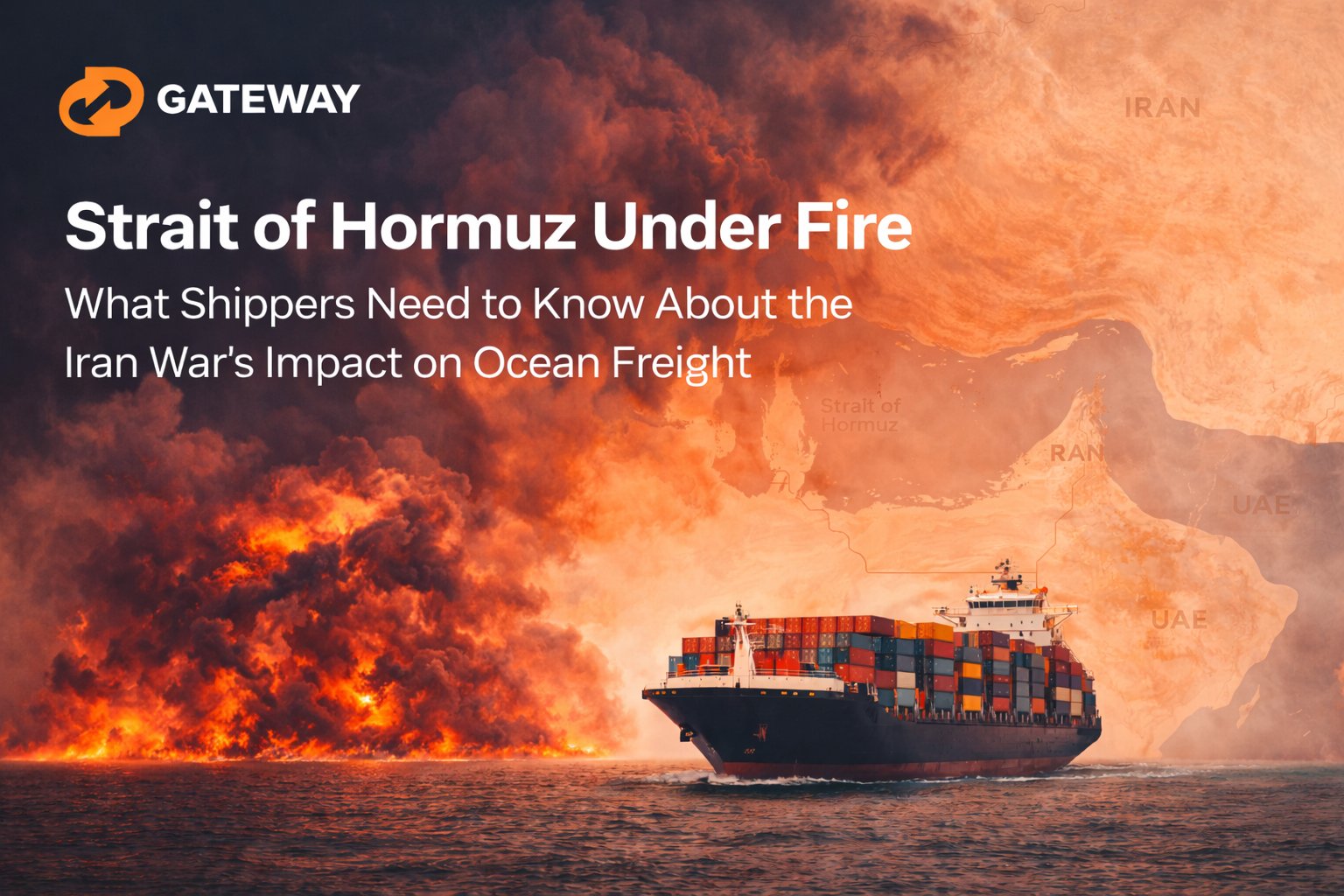
The Strait of Hormuz Is Effectively Closed
On February 28, 2026, the United States and Israel launched coordinated military strikes on Iran under Operation Epic Fury. Within days, Iran's Islamic Revolutionary Guard Corps declared the Strait of Hormuz closed and threatened to attack any vessel attempting to transit the waterway.
The Strait of Hormuz is a narrow passage between Iran and Oman connecting the Persian Gulf to the open ocean. Roughly 20 million barrels of crude oil pass through it daily — approximately one-fifth of global oil consumption. It also carries 19% of the world's liquefied natural gas (LNG) flows and 14% of global refined product trade.
Tanker traffic through the strait dropped by approximately 70% within the first 48 hours of the conflict. By March 2, traffic had essentially reached zero as commercial operators withdrew entirely. Over 150 ships anchored outside the strait to avoid the risk zone.
As of Day 12 of the conflict (March 11, 2026), the IRGC has fired on and stopped vessels attempting to pass, at least nine ships have been damaged, two crew members have been killed, and roughly 200 vessels remain anchored off the coasts of Gulf oil producers.
Why This Is Worse Than the Red Sea Crisis
The Houthi attacks on Red Sea shipping between late 2023 and early 2025 disrupted global trade and forced carriers to reroute around the Cape of Good Hope. The Strait of Hormuz crisis is far more severe for several reasons.
First, the volume at stake is exponentially larger. The Red Sea disruption affected container trade primarily. The Hormuz closure affects crude oil, refined products, LNG, LPG, and container trade simultaneously. It is a supply disruption, not just a logistics inconvenience.
Second, Iran's military capability far exceeds that of the Houthis. Iran can reach every point in the Strait of Hormuz with anti-ship cruise missiles, drones, fast attack craft, and naval mines. Military analysts have described the situation as "much greater" in risk than the Red Sea, requiring "far more substantial" countermeasures.
Third, the insurance market has collapsed for the region. During the Red Sea crisis, war risk premiums rose but coverage remained available. In the Hormuz crisis, major insurers including Norway's Gard and Skuld, Britain's NorthStandard, the London P&I Club, and the American Club have completely canceled war risk coverage for vessels in the Gulf. Without insurance, ships cannot legally or commercially sail.
Impact on Freight Rates and Costs
The financial impact on shipping has been immediate and dramatic.
VLCC (Very Large Crude Carrier) rates for the Middle East to China route hit an all-time record of $423,736 per day — a 94% increase in a single session. War risk insurance premiums jumped from 0.125% to between 0.2% and 0.4% of vessel value per transit before coverage was pulled entirely. For a very large oil tanker, that represented a quarter-million-dollar increase per voyage even before insurers withdrew.
Container carriers have responded with emergency surcharges. Hapag-Lloyd introduced a War Risk Surcharge of $1,500 per TEU and $3,500 per container for reefer and special equipment shipments to and from the Arabian Gulf. Other major carriers including MSC, Maersk, and CMA CGM have suspended special cargo acceptance in the UAE and surrounding region.
Brent crude oil surged past $100 per barrel. The International Energy Agency agreed to release a record 400 million barrels from strategic reserves to attempt to stabilize prices — a move that underscores the severity of the disruption.
Which Trade Lanes Are Affected
The disruption extends well beyond the Persian Gulf. Here are the trade lanes experiencing direct impact.
Persian Gulf origins and destinations — Any cargo moving through the Strait of Hormuz is currently unshippable through normal commercial channels. This includes ports in the UAE (Jebel Ali, Khor Fakkan), Saudi Arabia (Dammam, Jubail), Qatar (Hamad Port), Kuwait, Bahrain, and Iraq (Umm Qasr). Jebel Ali is one of the world's largest transshipment hubs, meaning cargo routed through it from Asia, Africa, or Europe faces delays even if the origin and destination are outside the Gulf.
Red Sea and Suez Canal — Houthi forces in Yemen have signaled they may resume attacks on commercial shipping, which would effectively re-close the Bab al-Mandab strait. Carriers that had begun returning services to the Suez Canal route in early 2026 are now reversing those decisions. CMA CGM has already rerouted its FAL1, FAL3, and MEX services back to the Cape of Good Hope.
Asia to Europe — Container services connecting Asian manufacturing centers to European markets are experiencing cascading delays. Approximately 10% of the world's container fleet is caught in the broader disruption. Port congestion is building at transshipment hubs in Asia and Europe as backlogs develop.
Energy trade globally — Countries dependent on Gulf oil and gas face the most acute pressure. Japan imports roughly 70% of its Middle Eastern oil through the Strait of Hormuz. European natural gas prices have spiked as Qatar — a major LNG supplier — declared force majeure on gas contracts after halting production.
What Carriers Are Doing
Major ocean carriers have taken the following actions as of March 11, 2026.
Maersk has suspended special cargo acceptance in and out of the UAE and is rerouting services via the Cape of Good Hope where possible. The ME11 and MECL services have been diverted.
CMA CGM reversed its decision to return services to the Red Sea, citing the "complex and uncertain international context." Multiple services are back on Cape of Good Hope routing.
Hapag-Lloyd introduced War Risk Surcharges effective March 2 for all Arabian Gulf and Upper Gulf cargo.
ONE (Ocean Network Express) warned that approximately 10% of the global container fleet is affected by the broader disruption, with cargo at risk of piling up at ports and transshipment hubs.
MSC has issued fresh guidance prioritizing crew and cargo safety and adjusting schedules across affected regions.
Insurance: The Hidden Chokepoint
The real barrier to resuming Hormuz transit is not military — it is insurance. Commercial ships do not sail without coverage. Port authorities, charterers, banks, and regulators all require adequate marine insurance as a condition of operation.
With major Protection & Indemnity (P&I) clubs pulling war risk coverage from the Gulf, ships physically cannot operate in the region regardless of whether the strait is technically open. P&I coverage was specifically removed as of March 5, making transit economically impossible for shipowners.
War risk insurance premiums have increased by over 1,000% in some cases. France's transport minister described the rates as "insane." Insurance experts warn that even after a ceasefire, it could take weeks or months for underwriters to reinstate coverage at commercially viable rates.
President Trump announced that the U.S. Development Finance Corporation would provide political risk insurance for maritime trade in the Gulf and that the U.S. Navy would escort tankers through Hormuz if necessary. Whether this is sufficient to restart commercial traffic remains unclear.
What Importers and Exporters Should Do Now
If you ship cargo through or near the Persian Gulf, the Red Sea, or the Suez Canal, take these steps immediately.
Audit your supply chain exposure. Identify every shipment currently in transit, booked, or planned that touches affected trade lanes. Determine whether cargo is routed through Jebel Ali, Khor Fakkan, or any Gulf transshipment hub.
Communicate with your freight forwarder. If your forwarder hasn't proactively contacted you about this disruption, that's a red flag. You need real-time intelligence on carrier schedule changes, surcharges, and alternative routing.
Expect cost increases. War Risk Surcharges, Bunker Adjustment Factors tied to rising oil prices, congestion surcharges, and extended transit time costs are all hitting simultaneously. Budget for 15–30% increases on affected lanes as a starting point.
Review your cargo insurance. Standard marine cargo policies typically exclude war and terrorism. If your cargo is in or near the conflict zone, confirm whether your policy provides coverage. If not, speak with your broker about standalone war risk cargo insurance immediately.
Consider alternative sourcing. If you rely heavily on suppliers in the Gulf region, evaluate whether temporary alternative sources outside the conflict zone are viable. Diversification is no longer optional — it is a survival strategy.
Extend your planning horizon. Transit times on rerouted services (Cape of Good Hope instead of Suez) add 10–14 days to Asia-Europe voyages. Factor this into production schedules, inventory planning, and customer commitments.
How Long Will This Last
No one can predict when the Strait of Hormuz will reopen for normal commercial traffic. Military analysts have stated that reopening requires the elimination of Iran's offensive coastal installations, constant monitoring, patrols, and a level of intelligence assessment that is not achievable in the near future.
Even after a ceasefire, the insurance market will need time to reassess risk and reinstate coverage. Port infrastructure in the Gulf may require inspection and certification. Carrier networks that have been rerouted will take weeks to normalize.
The most realistic scenario is that significant disruption continues through at least Q2 2026, with elevated costs and extended transit times persisting well beyond that. Shippers should plan for a minimum of 3–6 months of abnormal conditions on any trade lane connected to the Middle East.
Gateway Lines Is Monitoring in Real Time
Gateway Lines' Freight Intelligence platform provides live satellite tracking, AI-powered ETA predictions, and real-time disruption alerts across all affected trade lanes. Our team is actively monitoring carrier schedule changes, surcharge updates, and routing adjustments as the situation develops.
If you have cargo in transit through the Gulf or Red Sea region, or if you need to evaluate alternative routing for upcoming shipments, contact our operations team immediately.
We are also assisting customers with cargo insurance reviews through our partnership network, ensuring your shipments are properly covered in the current high-risk environment.
Need immediate assistance? Get a Quote · Talk to an Expert · Track Your Shipment
Related Articles: